The short answer: yes. According to the Self Storage Association, virtually all self-storage rentals operate on month-to-month leases. No annual contract required. This guide covers what month-to-month storage actually means, who it works best for, what to watch in your rental agreement, and where to find flexible options near Stewartville and Rochester, MN.
Key Takeaways
- Most self-storage facilities rent month-to-month — your lease renews automatically until you give notice to move out
- Expect a 10–30 day notice requirement before moving out — month-to-month leases aren't notice-free
- Flexible storage works best for moves, renovations, seasonal needs, and life transitions
- Before signing, check the notice period, rate increase clauses, and insurance requirements
- Bear Cave Storage in Stewartville offers units from 10×10 up to 20×40, plus outdoor vehicle and RV spaces — all on flexible rental terms
What Does Month-to-Month Storage Actually Mean?
Month-to-month storage means your lease automatically renews each billing cycle rather than locking you into a 6- or 12-month term. You pay for the current period, then decide whether to continue — with no penalty for stopping as long as you give proper notice.
This is the standard model across the industry, not a premium feature. Most renters won't be asked to sign a long-term contract.
What It Doesn't Mean
Month-to-month doesn't mean you can walk away without warning. A few details renters frequently overlook:
- Notice is required — most facilities ask for 10–30 days' written notice before move-out. Miss that window and you'll owe another month's rent.
- Billing resets monthly, not daily. If your rent renews on the 1st and 10 days' notice is required, you'd need to notify by the 21st of the prior month to avoid another charge.
- Proration isn't always offered. Some facilities bill for the full month regardless of your move-out date — always check the rental agreement before signing.
Bear Cave Storage's Contract Options
Bear Cave Storage in Stewartville offers three distinct payment structures:
| Contract Term | Discount |
|---|---|
| Month-to-month | Standard rate |
| 6-month lease | 5% off monthly rate |
| 12-month lease | 10% off monthly rate |
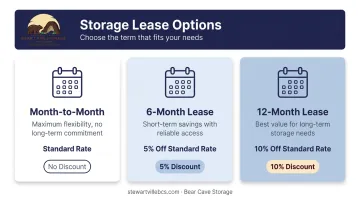
Month-to-month works well when your timeline is uncertain; the longer leases reward you with a lower rate if you know how long you'll need the space.
Who Benefits Most from Month-to-Month Storage?
StorageCafe's 2025 research found that about 1 in 3 Americans currently rent self-storage, with moving accounting for 44% of all storage use cases.
People Between Homes
Month-to-month storage is built for the gap between a move-out date and a move-in date. Home closings get delayed. Lease start dates shift. In a market like Stewartville and Rochester, where Mayo Clinic employment drives frequent relocations, flexible storage removes the pressure of coordinating two timelines perfectly.
Homeowners Doing Renovations
Clearing out a room during flooring replacement, a kitchen remodel, or a painting project is a classic short-term need. You don't want a 12-month lease for a 6-week job. Month-to-month lets you move things in, get the work done — then move everything back when the job's done.
Minnesota Seasonal Storage
This one's especially relevant locally. With Rochester averaging 48.1 inches of snow per season and January temperatures around 11.8°F, plenty of items spend half the year in storage:
- Outdoor furniture and patio equipment
- Lawn mowers and snowblowers (swapped seasonally)
- ATVs, boats, and kayaks
- Holiday decorations and seasonal gear
That kind of cyclical use is exactly what month-to-month terms are designed for.
Life Transitions
Several common life changes create unpredictable storage timelines:
- Divorce or separation requiring temporary furniture storage
- Downsizing after retirement with items not yet rehomed
- A college student returning home for the summer
- A family member moving in and displacing belongings
In each case, you rarely know how long you'll need the space. Month-to-month removes that guesswork.
Small Business Owners
Bear Cave Storage actively serves contractors, small business owners, and commercial customers who need secure space for equipment, inventory, or tools. Month-to-month flexibility matters here because business storage needs fluctuate — a contractor finishing a project doesn't want to keep paying for space they no longer need.
Key Things to Understand Before Signing
Notice Period Requirements
Month-to-month flexibility has one catch most renters miss: the notice requirement. Most facilities require at least 30 days' advance written notice before you vacate — and missing that window typically triggers another full month's charge.
Ask before you sign: "What is your required notice period, and how do I submit it?"
Rate Increase Clauses
Month-to-month leases allow facilities to adjust rates over time. The facility must give you advance written notice before any increase takes effect. Check your agreement for the specific notice window and whether rate changes apply to existing renters or only new ones.
Ask before you sign: "How much notice do you give before a rate increase, and has pricing changed for long-term renters?"
Late Payments and Minnesota Lien Law
Under Minnesota Statutes §514.970–514.979, the "Minnesota Liens on Personal Property in Self-Service Storage Act," the process after a missed payment works like this:
- Default begins 15 days after rent is due and unpaid
- The facility must send written notice demanding payment within at least 14 days
- A sale of contents may occur no sooner than 45 days after default (60 days for vehicles or watercraft)
- The facility must advertise the sale in a local newspaper once per week for two consecutive weeks
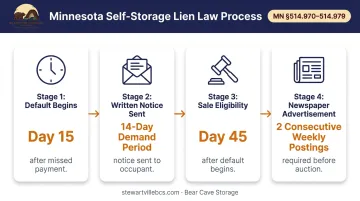
If a payment becomes a problem, contact the facility early. The statute gives renters meaningful time to resolve the situation before it escalates.
Insurance Requirements
Storage facilities are not responsible for insuring your belongings — this must be disclosed in your rental agreement under Minnesota law.
Your options:
- Check your existing policy first. Renters or homeowners insurance may cover belongings stored off-premises, though coverage can be limited — Nationwide notes this is often capped at around 10% of your personal property coverage.
- Purchase facility coverage. Bear Cave Storage offers optional Tenant Protection as an add-on. Contact them at (507) 533-6185 for current plan details.
Month-to-Month vs. Long-Term Contracts: Which Makes More Sense?
The honest answer: it depends on how confident you are about your timeline.
When a longer term makes sense:
- You're storing inventory or equipment for a business with predictable ongoing needs
- You're in an extended renovation with a fixed end date
- You're certain you need storage for 6–12 months and want the lower rate
When month-to-month wins:
- Your timeline is uncertain (most personal storage situations)
- You might sell your home sooner than expected
- The renovation could finish early — or run long
- A life situation could resolve on its own schedule
The financial case comes down to one scenario: if you're on a 12-month contract and your situation resolves in month four, you're paying for eight months of empty space. That's a real cost — and it's exactly why the flexibility of month-to-month tends to be worth the slightly higher rate.
Practical tip: Start month-to-month. You can always ask about switching to a longer-term rate later — but exiting a fixed contract early typically means penalties or forfeited payments.
Finding Month-to-Month Storage in Stewartville, MN
The Local Context
Stewartville's population grew from 5,916 in 2010 to an estimated 6,919 in 2024, according to Census QuickFacts. It sits in Olmsted County with direct ties to Rochester, where Mayo Clinic reported $10.5 billion in staff pay and benefits in 2024. That kind of economic activity drives consistent movement of residents, healthcare workers, and families relocating for work — and with it, real demand for short-term, flexible storage.
Residents in Byron, Racine, and Pine Island face the same seasonal and transitional storage needs without a lot of local options nearby.
What to Look for in a Local Facility
- Proximity and access hours — A facility close to home matters when you're loading and unloading. Look for gated access that runs around the clock, not just during business hours.
- Drive-up capability — For moving furniture, equipment, or vehicles, drive-up access is a practical necessity, not a bonus. Bear Cave Storage provides it across their full indoor unit lineup.
- Indoor vs. outdoor options — Minnesota winters make this a real decision. Bear Cave offers enclosed indoor units (10x10 up to 10x30, plus a 20x40) alongside fenced outdoor storage for vehicles, RVs, boats, and trailers.
- Online management — Online rental and 24/7 bill pay let you set up and manage your unit without an in-person visit.

About Bear Cave Storage
Bear Cave Storage is a local, family-owned facility at 311 11th Ave NW in Stewartville, MN, serving residents throughout the Rochester area — including Byron, Racine, and Pine Island. They hold a 4.6-star rating and offer both month-to-month and longer-term rentals across a full range of unit sizes.
For availability and pricing, reach them at (507) 533-6185 or sales@bearcavestorage.com. Office hours run 9 AM to 5 PM, seven days a week.
Frequently Asked Questions
Are storage units month to month?
Yes — the Self Storage Association reports that virtually all self-storage facilities rent on a month-to-month basis. Your lease renews automatically each month until you give proper notice to move out. No annual contract is required at most facilities.
How much notice do I need to give before moving out of a storage unit?
Most facilities require between 10 and 30 days' written notice before your move-out date. Failing to give proper notice typically means being charged for an additional full month, so confirm this in your rental agreement before signing.
Can I switch to a larger or smaller unit if my needs change?
Most month-to-month facilities allow unit transfers without penalty, subject to availability. Bear Cave Storage offers indoor units from 10x10 to 10x30, plus a 20x40 option, so downsizing or upgrading is generally straightforward.
What happens if I miss a payment on my storage unit?
Under Minnesota law, default begins 15 days after rent is due, and a facility cannot sell contents until at least 45 days after default. Written notice is required before enforcement proceeds. Contact the facility early if payment becomes a problem.
Do I need insurance for a storage unit?
Yes. Facilities are not liable for your belongings, so check your homeowners or renters policy first — off-premises coverage may already apply. Bear Cave Storage also offers optional Tenant Protection coverage if you need a dedicated plan.
What's the difference between indoor and outdoor storage units?
Outdoor drive-up units offer easy loading access and tend to cost less, but provide no weather protection beyond a roof. Indoor units keep belongings enclosed and shielded from Minnesota's temperature swings — important for wood furniture, documents, or anything sensitive to cold and moisture.