Key Takeaways
- Before buying anything, map your storage zones: console, under-seat, deck, and bow
- Critical safety gear (life jackets, flares, fire extinguisher) must stay accessible, not buried
- Purpose-built marine products outperform repurposed household items in UV and moisture resistance
- Organization starts with removing what doesn't belong onboard, not adding more organizers
- Off-season gear belongs in secure storage, not taking up prime onboard space year-round
Picture this: you're five minutes from the launch ramp, and you can't find the boat keys because they're buried under a rain jacket, three water bottles, and a tackle box that somehow ended up on the passenger seat. The sunscreen is wedged between the console and the seat cushion. A rod is leaning against the gunwale at a precarious angle.
Limited deck space doesn't cause this problem — lack of a system does. According to 2024 USCG data, improper loading contributed to 54 recreational boating incidents and 25 deaths in a single year. Disorganization isn't just frustrating; on the water, it's a genuine safety issue.
This guide covers practical zone-by-zone storage solutions for your console, helm, and deck — including both DIY approaches and purpose-built marine products. It also covers what gear simply doesn't need to live on the boat at all.
Start Here: Assess What Your Boat Actually Needs
Before you order a single organizer or pick up a drill, spend 15 minutes doing a full inventory of what actually lives on your boat.
The "Everything Needs a Home" Principle
List every item you bring aboard regularly, then group them by access frequency:
- Every trip: Keys, phone, sunglasses, safety gear, fishing tackle, snacks, sunscreen
- Most trips: Extra line, basic tools, foul-weather gear, first aid kit
- Occasionally: Spare parts, extra fenders, ski equipment, extra anchors
Items in the first group should be within arm's reach from your operating position. Items in the second group belong in an organized compartment nearby. Occasional-use gear doesn't belong in prime real estate.
Map Your Storage Zones
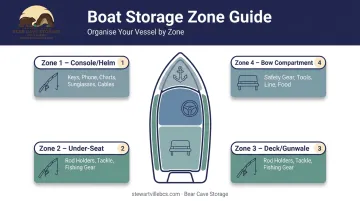
Treat the boat like a floor plan — each area has a purpose:
| Zone | Best For |
|---|---|
| Console/helm | Keys, phone, charts, sunglasses, charging cables |
| Under-seat | Safety gear, tools, spare line, food/beverages |
| Deck/gunwale | Rod holders, tackle, items needed while fishing |
| Bow compartment | Anchor, rope, fenders, rarely accessed gear |
The Minnesota DNR's 2026 Boating Guide requires that life jackets be "readily accessible" — not in sealed bags, under heavy objects, or locked containers. A throwable device on boats 16 feet or longer must be "immediately available," meaning in the open. Storage planning has to account for legal accessibility requirements, not just convenience.
This inventory also tends to surface gear that belongs in off-season storage — not taking up space onboard all season long.
Console & Helm Storage Solutions
The console area has unique constraints. Surfaces are limited, spray is constant, and anything you place there will launch across the cockpit the moment you hit a wake. Everything at the helm needs to be fastened down, not just set there.
Mounted Pockets and Mesh Bags
Adhesive-backed mesh or canvas pockets that mount on the inside of console doors or on the dash panel itself are one of the simplest upgrades you can make. They're ideal for:
- Sunglasses and reading glasses
- Phone (non-charging)
- Registration documents and insurance card
- Small tools like a multi-tool or knife
Mesh is worth choosing over solid fabric here — wet items drip-dry without trapping moisture against the surface.
For setups where drilling isn't an option (rented slips, shared boats), marine-rated suction cup mounts work as an alternative. RAM Mounts' B-size Twist-Lock suction mount handles up to 2 lbs in standard use — suitable for a phone or small instrument, but not a heavy fish finder. Check the manufacturer's load rating before mounting anything heavier.
Rod Holders and Tackle Organization
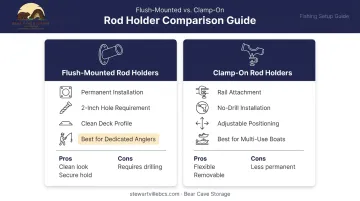
Two main options exist for rod storage at the console:
- Flush-mounted rod holders (like T-H Marine's flat-top model, which installs in a 2-inch hole with a 1.5-inch inside diameter) are the cleaner, more permanent choice for regular anglers
- Clamp-on holders (like Rupp's vertical clamp-on, available in pipe sizes from 0.75 to 1.25 inches) attach to rails without drilling — better for flexibility or boats used for multiple purposes
Either way, storing rods vertically clears walking space and protects tips from breakage.
For tackle, horizontal caddies that mount near the cockpit keep pliers, lures, and line cutters accessible in individual slots. The goal is to avoid having an open tackle box on the deck while fishing — a guaranteed trip hazard.
Charging and Electronics Management
Gear clutter and cable clutter create the same problem — something underfoot or in the way at the wrong moment. At the helm, loose cables are a safety issue. Practical fixes:
- A shallow drawer with a USB hub inside creates a dedicated charging station that keeps devices off the dash
- Velcro cable ties bundle cords against the console frame
- A mounted clip or pocket holds the device being charged so it doesn't slide during turns
Keep every electronic device either mounted or stowed. A device that slides off the dash mid-turn becomes a distraction — or a hazard — at exactly the wrong time.
Deck and Under-Seat Storage Ideas
Most boats have more usable storage volume than owners realize. The problem isn't capacity — it's that deep lockers become black holes where gear disappears.
Under-Seat Drawers and Bins
Two approaches work well here:
Slide-out drawers installed under bench seats maximize organization but require some installation work. They're worth it for items accessed constantly, like safety gear or tools.
Soft-sided canvas or mesh bins are a faster solution. They conform to irregular locker shapes — a common reality on production boats — pull out entirely so you're not reaching blindly into a dark corner, and wash easily. Drop a few inside a large under-seat compartment and you've effectively subdivided it.
Either way, store anything important in clear bags or labeled bins. Safety gear — flares, first aid supplies, fire extinguisher — should never require a search. The USCG federal equipment guide is clear that visual distress signals must be readily accessible; burying them under life jackets and extra rope defeats the purpose.
Overhead Netting and T-Top Bags
Overhead cargo netting strung between bow rails works well for lightweight, bulky items: towels, dry bags, inflatable life jackets. The limit here is motion — netting offers no lateral support in rough water, so only genuinely lightweight items belong there.
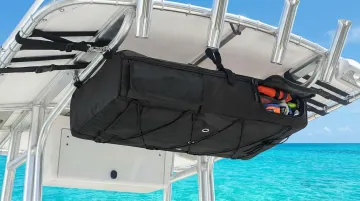
T-top and bimini bags are a step up. Two reliable options:
- C.E. Smith T-top bag — 25 x 20 x 6 inches, holds four life jackets, 600-denier polyester with a mesh top for drying wet gear
- Airhead T-Bag — fits four to six life jackets, same 600-denier UV and water-resistant construction
Both attach with straps to the frame — no drilling required.
When shopping, look for UV-resistant, water-resistant materials. A household bag mounted under a T-top will degrade within a season.
Bungee Cord and Shock Cord Systems
A grid of crisscrossed bungee cords mounted on a bulkhead or the inside of a gunwale panel is one of the most adaptable storage systems on a boat. It holds charts, cutting boards, and odd-shaped gear that won't fit in bins. Two ways to set it up:
- Multiple short cords clipped point-to-point across a flat panel — flexible and easy to reconfigure
- A single longer cord run through evenly spaced hooks in a zigzag — cleaner appearance, more uniform tension
Ronstan's shock cord hooks (UV-stabilized nylon, suited for 6–8mm cord) are a marine-grade option that won't degrade in sun and spray the way generic hardware-store hooks will.
Galley and Cabin Organization Hacks
Even a small cuddy cabin benefits from deliberate organization. The galley is where disorganization most directly affects comfort — a loose knife in a drawer, dishes sliding off a shelf, spice jars rolling into a bilge.
Collapsible and Silicone Tools
Silicone collapsible items (bowls, colanders, measuring cups, buckets) are among the most practical galley upgrades for a boat. They fold flat when not in use, rinse clean in salt or fresh water, and don't shatter. A collapsible bucket earns double duty: galley use and deck rinse-downs after a fishing trip.
Common collapsible items worth keeping aboard:
- Silicone bowls and colanders for food prep
- Measuring cups that stow flat in a drawer
- A collapsible bucket for deck washdowns and galley tasks
Magnetic Strips and Smart Fastening
A magnetic strip on a bulkhead solves the knife-and-utensil problem: keeps them accessible and stops them from sliding into a jumbled drawer. One practical caveat — mount the strip away from any compass, since magnetic fields affect compass accuracy.
Pair magnetic strips with velcro tabs for non-metal items: condiment pouches, spice packets, phone holders. Velcro on vertical surfaces turns otherwise wasted bulkhead space into functional storage.
Quick Wins for Provisions and Dishes
Once fastening is sorted, the next challenge is provisions and dishware. Two solutions that work well in tight cabin spaces:
- Bead storage organizers (small sealed plastic jars in a compact case) let you bring only the spices and condiments needed per trip rather than full-size bottles that roll around and waste space
- Magazine organizers used to store dishes on-end keep plates from sliding and clattering — the open sides also ventilate moisture, which helps prevent mildew in an enclosed cabin
Hanging shoe organizers repurposed for toiletries or snacks, hung on a door or bulkhead, turn flat door surfaces into functional storage without touching the hull.
Smart Add-Ons: Commercial Products Worth Buying
Some storage problems genuinely require purpose-built marine products. Household alternatives fail in UV exposure, salt, and the constant motion of a boat.
Worth buying in marine-grade versions:
- Rail bags and transom bags — look for UV-treated, water-resistant fabrics (600-denier polyester is a reliable benchmark). Generic bags fade, crack, and delaminate within a season
- Vacuum storage bags — ideal for cushions, blankets, and spare clothing. They compress bulk items down significantly and create an airtight, waterproof seal — useful for deep compartments that may see moisture
- Folding tables and stackable marine chairs — these let a cockpit function as a working deck underway and a gathering space at anchor without permanently sacrificing floor space
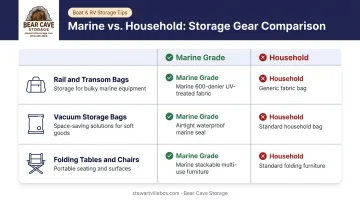
If something is permanently mounted or lives outdoors on the boat, buy the marine version. If it lives in a sealed cabin compartment or is brought aboard and removed each trip, a household version often works fine.
What Doesn't Need to Stay on the Boat
A well-organized boat is as much about editing as it is about adding. Most boaters carry gear year-round that sees use three or four times a season — and all of it competes for the same limited space. Common culprits include:
- Extra fenders and dock lines used only occasionally
- Ski and wakeboard equipment stored between sessions
- Spare parts boxes rarely needed mid-season
- Off-season clothing and rain gear
At the end of each season, pull everything non-essential off the boat. Decide what actually needs to come back in spring, and store the rest somewhere secure.
In Minnesota, this habit pairs naturally with the seasonal calendar. Minnesota's lake ice-out dates vary by year and location, but winter storage is a reality for every boater in the state. Sea Tow notes that water expands about 9% when freezing and can crack engine blocks or delaminate fiberglass — which means proper off-season storage isn't optional.
For boaters in the Rochester and Stewartville area, Bear Cave Storage offers fenced outdoor spaces and enclosed indoor units sized for boats and trailers. The 10x30 and 20x40 indoor units accommodate larger boats with trailers; outdoor fenced spaces start under $100/month for seasonal storage.
Rentals are available month-to-month or with discounts for 6- or 12-month prepayment. Drive-up access and 24/7 gated security make drop-off and retrieval straightforward, whether you're pulling the boat in October or picking it up for an early May trip.
The less your boat doubles as a storage shed, the more useful every square foot of deck space becomes.
Frequently Asked Questions
What is the cheapest way to store a small boat?
Outdoor uncovered storage — either at home or at a facility — is the least expensive option, typically ranging from around $20–$50 per foot annually according to Sea Tow. Covered outdoor and enclosed indoor storage cost more but offer meaningful protection from UV damage, weather, and freeze risk, which matters in Minnesota's winters.
What storage solutions work best for a center console boat?
The open layout of a center console benefits most from mounted mesh pockets on the console, T-top bags overhead for life jackets and gear, flush or clamp-on rod holders along the gunwale, and rail bags mounted along the sides. Together, these keep critical gear within arm's reach on the water.
How do I keep my boat organized during a day trip?
Assign a fixed home to every item before leaving the dock. Carry a small dry bag or zippered pocket for personal items (keys, phone, wallet, sunglasses) that never gets set down elsewhere. Safety gear — life jackets, flares, fire extinguisher — should return to the same dedicated spot after every use.
How do I maximize storage on a pontoon boat?
Under-seat storage bins, stern storage lockers, and bow compartments are the primary capacity areas. Hanging rail bags along the pontoon railing add accessible storage for frequently used items without taking up deck space. Label bins clearly so passengers can find what they need.
What items should I always keep stored on my boat?
At minimum, every boat should carry:
- A USCG-approved life jacket for every person aboard
- A Type IV throwable device (boats 16 feet and over)
- Fire extinguisher, visual distress signals, and a sound-producing device
- Current registration and documentation
- A basic first aid kit
Keep these in clearly labeled, dedicated spots — never buried under other gear.
How do I prevent gear from getting damaged in wet boat storage compartments?
Use waterproof or water-resistant bags and bins inside compartments, and choose mesh or open-sided containers wherever possible to allow airflow. West Marine recommends adding moisture absorbers to closed lockers and using vacuum-sealed bags for fabric items like cushions and clothing to prevent mildew buildup.