Introduction
Self-storage has become one of the more reliable real estate investments in the U.S. over the past decade. Population movement, downsizing trends, and consistent demand from both households and small businesses have kept occupancy rates healthy — even through economic downturns.
That consistency draws a wide range of aspiring operators: real estate investors sitting on land, career changers looking for a tangible local business, and first-time entrepreneurs who want recurring income without the complexity of retail or food service.
According to the Self Storage Association's 2025 Demand Study, 12.6% of U.S. households — roughly 16.7 million — currently rent a storage unit. Opening a self-storage facility is not a passive endeavor. It requires upfront capital, a realistic understanding of local demand, and the patience to manage an 18–24 month ramp-up before the numbers start looking like what you expected. This guide walks through what that process actually looks like, from site selection to opening day.
Key Takeaways
- Self-storage businesses rent individual lockable units monthly — demand is consistent and relatively recession-resistant
- Location, unit mix, and pricing are the most critical early decisions
- New facilities typically take 12–24 months to reach 80–90% occupancy, the threshold most operators target for stabilization
- Well-run facilities can reach 40–60% profit margins once stabilized, depending on occupancy and local pricing
- This is a long-term asset-building play, not a quick-return business
What Is a Self-Storage Business (and What Does Running One Actually Look Like)?
A self-storage business is straightforward in concept: you own or lease a property, divide it into individual units of varying sizes, and rent those spaces monthly to customers who need somewhere to store their belongings.
The unit range is wide. Most facilities offer everything from compact 5×5 spaces for boxes and seasonal items up to large 10×30 units or 20×40 bays for vehicles, boats, or business inventory. Bear Cave Storage in Stewartville, Minnesota, for example, offers indoor units ranging from 10×10 to 10×30, plus a 20×40 space, along with enclosed indoor vehicle storage and fenced outdoor spaces for RVs, boats, and trailers — all with drive-up access and 24/7 gated security.
Business Formats
The format you choose affects everything from startup cost to daily workload:
- Single-location, owner-operated — Most common for first-time operators; you manage leasing, maintenance, and customer issues directly
- Multi-site operations — Requires more capital and management infrastructure, but benefits from scale
- Franchise models — Lower risk, more support, but fees reduce margin
- Third-party managed — An outside company handles day-to-day operations; useful once you've stabilized but adds cost
What Day-to-Day Operations Actually Look Like
Self-storage requires less direct labor than most brick-and-mortar businesses — but it's not passive, especially early on. Expect active involvement in:
- Handling new leases and tenant inquiries
- Setting and adjusting pricing
- Managing maintenance and unit turnovers
- Tracking delinquencies and following your state's lien process
Modern management software (more on this in Step 4) handles online reservations, automated billing, and lease management. That's how owner-operated facilities like Bear Cave Storage offer 24/7 online rental and bill pay without round-the-clock staffing.
But systems take time to set up and refine. The "low-touch" model is earned, not automatic.
Why Start a Self-Storage Business?
Self-storage isn't a guaranteed win. It works well under specific conditions, and those conditions are worth examining honestly before committing capital.
When the Math Works in Your Favor
The business model has genuine structural advantages:
- Recurring monthly revenue across dozens or hundreds of tenants, reducing the impact of any single vacancy
- Low staffing requirements relative to other commercial properties
- Multiple customer types — residential households, small businesses, contractors, vehicle owners — reducing dependence on any one segment
- Strong lender confidence — SBA 7(a) loans can fund self-storage acquisitions and development, with startup ventures generally requiring at least 10% equity injection (confirm specifics with an SBA lender)
The Demand Picture
The 2025 Self-Storage Almanac labels the Minneapolis–St. Paul metro as under-supplied, with estimated demand running at 6.53 sq ft per capita versus current supply of 5.76 sq ft per capita. That's a metro-level signal, not a guarantee that every submarket is equally underserved. Local validation still matters.
The Storage & Warehouse Leasing category has grown at a 3.8% CAGR from 2021 to 2026, according to IBISWorld — steady growth that reflects consistent consumer demand rather than a speculative spike.
The Conditions That Favor New Entrants
Those demand numbers only translate into a viable business when your local market supports them. A self-storage startup makes the most sense when:
- Local supply is genuinely limited (few competitors, long drive times to alternatives)
- Demographics support demand — growing population, military presence, college enrollment, or significant retiree downsizing
- Available land is reasonably priced relative to construction costs
- The local rental rate environment supports a viable pro forma
Early Decisions That Shape Your Self-Storage Business
Most early self-storage failures trace back to financial and analytical blind spots, not operational ones. Operators commit capital before verifying local demand, or build a facility whose cost structure can't survive local pricing — and by the time either problem shows up, options are limited.
True Startup Costs
Construction costs vary significantly by format. Using figures from Trachte's cost calculators:
| Facility Type | Cost Per Sq Ft | 10,000 Sq Ft Project |
|---|---|---|
| Drive-up, single-story | $45–$55/sq ft | $450,000–$550,000 |
| Climate-controlled | $65–$75/sq ft | $650,000–$750,000 |
| Hard costs + soft costs (15–25%) | $65–$85/sq ft + soft costs | $650,000–$1M+ |
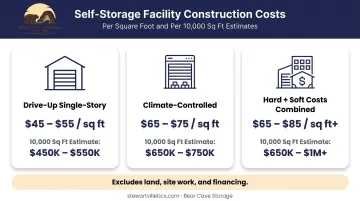
These figures exclude land, site work, and financing costs. In Minnesota specifically, construction cost indices have shown notable year-over-year increases — budget for contingency and get local bids before finalizing any pro forma.
Realistic Timeline to Profitability
Most new facilities take 12–24 months to reach the 80–90% occupancy range that supports stable cash flow. Industry benchmarks suggest targeting 88–92% physical occupancy for a stabilized facility, though the actual break-even point depends on your specific debt service, operating costs, and rental rates — not a universal percentage.
Plan for this ramp-up explicitly in your financing. Running short on cash at month 14 because you modeled break-even at month 9 is one of the most avoidable errors in the business.
Location and Zoning Realities
Visibility from a busy road matters, but it's only one factor. Location decisions also hinge on:
- Zoning compatibility (commercial, industrial, or mixed-use — sometimes requiring a conditional use permit)
- Competition density within your 3–5 mile trade area
- Proximity to demand drivers: residential neighborhoods, schools, businesses, RV owners
- Accessibility and ingress/egress for large vehicles
In Minnesota, zoning is handled at the municipal level. A conditional use application in some cities must be submitted 30 days before the hearing. Entitlement — from initial application to final approval — can easily add 3–6 months to your project timeline, depending on the municipality.
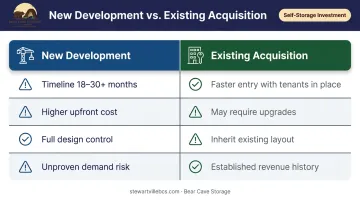
Build vs. Buy
| New Development | Existing Acquisition | |
|---|---|---|
| Timeline | 18–30+ months to open | Faster, tenants already in place |
| Cost | Higher upfront | May require upgrades |
| Control | Design to your specs | Inherit existing layout |
| Risk | Unproven demand | Established revenue history |
New development makes sense when local demand is undersupplied and you have the capital runway to weather a 24-month ramp-up. Acquisition is worth considering when an existing facility has occupancy below its potential — a value-add opportunity that reduces lease-up risk.
How to Open a Self-Storage Business — Step by Step
Five phases cover the full process. The most common failure points are noted at each stage — because knowing where operators go wrong is as useful as knowing what to do right.
Step 1 — Research Your Market and Validate Demand
Define your trade area (typically 3–5 miles) and answer these questions before spending money:
- How many competing facilities exist, and what are their approximate occupancy signals?
- What unit types are available — and what's missing? (No climate-controlled units? No RV storage?)
- What are competitors charging for 10×10, 10×20, and vehicle storage?
- Does local population growth, housing density, or commercial activity support the demand you need?
Use per-capita supply as a first screen, then validate with unit mix, local rents, housing data, and competitor pricing. Local moving companies and property managers often know exactly what customers want but can't find nearby.
Common miss: Confirming that demand exists, then discovering the local rental rate won't cover your cost structure. Run the break-even math before committing to a site.
Step 2 — Define Your Unit Mix and Build a Financial Model
A diversified unit mix serves more customer types and improves revenue per square foot. A facility offering only 10×10 units leaves money on the table from vehicle owners, business customers, and households needing larger spaces.
Bear Cave Storage's unit mix illustrates this well: indoor units from 10×10 to 20×40, plus enclosed indoor vehicle storage and outdoor fenced spaces at different price points ($58.50/month for outdoor up to $200/month for enclosed indoor). That range lets one facility serve residential renters, vehicle owners, and commercial tenants without adding a second location.
For financial modeling, run projections at 70%, 80%, and 90% occupancy across your unit types. Include:
- Monthly gross rental income at each occupancy level
- Fixed operating costs (taxes, insurance, utilities, management software, maintenance)
- Debt service based on your financing structure
- The month at which cash flow turns positive
Common miss: Pricing too low to attract early tenants, then being unable to raise rates without losing occupancy. Price to the market, not to what feels comfortable.
Step 3 — Handle Legal, Financing, and Site Setup
Legal basics for Minnesota operators:
- Register your business with the Minnesota Secretary of State (an LLC is common for liability protection)
- Confirm zoning approval and any conditional use requirements for your specific parcel
- Obtain required local permits before breaking ground
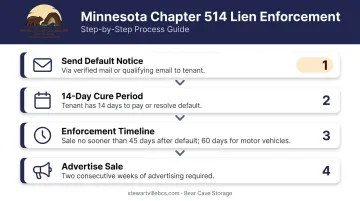
- Understand Minnesota Chapter 514 — the state's self-storage lien statute, which governs how you handle defaults, notices, and unit auctions
Under Chapter 514, lien enforcement requires:
- Default notice sent by verified mail or qualifying email
- At least 14 days for the tenant to pay before enforcement
- Sale cannot occur sooner than 45 days after default (60 days for motor vehicles)
- Sale must be advertised for two consecutive weeks
Financing options:
- SBA 7(a) loans — Can finance acquisition or development of owner-operated facilities; maximum generally $5M with real estate terms up to 25 years
- Conventional commercial real estate loans — Standard option for experienced operators or well-capitalized borrowers
- Seller financing — Sometimes available on acquisitions; can reduce upfront capital requirements
- Private equity or partnerships — Useful when land or capital access is limited
Common miss: Underestimating the permitting timeline. Budget 6–12 months for planning, design, and approvals before construction begins.
Step 4 — Build Your Facility and Set Up Operations
If building new, work with contractors who have specific self-storage experience. Unit module systems, door hardware, and drainage all differ from standard commercial builds. Define your unit sizes before finalizing the design, based on what market research showed was missing locally.
Customers are trusting you with possessions that matter to them. At minimum, your security setup should include:
- Gated entry with access code or keypad
- Digital video surveillance covering all access points and drive aisles
- Individual unit locks (disc or cylinder locks are standard)
Before opening, set up your management systems:
- Management software — Handles online reservations, automated billing, lease generation, and tenant communications. Bear Cave Storage, for example, runs on Storable, which enables 24/7 online rental and bill pay.
- Rental agreements and lien process — Document these before you accept your first tenant, not after you have your first delinquency
- Staffing model — Owner-operated, part-time manager, or third-party management company; the right answer depends on facility size and your availability
Where operators go wrong: Opening without a documented delinquency and auction process. In self-storage, tenant defaults are routine. Minnesota Chapter 514 has specific procedural requirements — skip a step, and you lose lien rights.
Step 5 — Launch, Market, and Stabilize
Before opening day, complete this marketing foundation:
- Claim and optimize your Google Business Profile — Local search is the primary discovery channel for storage customers
- **Build a website with online rental capability** — Customers expect to rent without calling
- List on self-storage aggregator platforms — These drive significant search traffic, especially for new facilities without established search rankings
- Consider introductory pricing — A modest discount for early tenants can accelerate initial occupancy without permanently anchoring your rates
Once open, track these metrics monthly:
- Occupancy rate by unit type
- Average rental rate per unit size
- Delinquency rate
- Cost per new tenant acquired
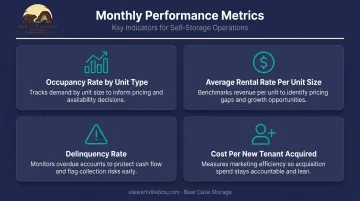
Use the data. If one unit type is consistently full while another sits at 60%, that's actionable information — either for pricing adjustments or future expansion planning.
Common miss: Assuming the facility will fill itself. In the first 18 months, occupancy management is an active job. Passive marketing rarely gets a new facility to stabilization — typically 85–90% occupancy — on its own.
Conclusion
Opening a self-storage business is achievable for first-time operators — but only if the groundwork is solid. The facilities that perform well long-term share a few common traits: they validated demand before committing capital, built financial models that accounted for a realistic ramp-up, and put compliant operational systems in place before taking their first tenant.
Bear Cave Storage, a locally owned facility serving households, businesses, and vehicle owners in the Rochester and Stewartville, Minnesota area, reflects that approach: a diverse unit mix spanning indoor units, enclosed vehicle storage, and fenced outdoor spaces, paired with 24/7 gated access and flexible rental terms. Start with those fundamentals, and the operational side follows.
Frequently Asked Questions
How much money can you make owning a storage business?
Income varies widely based on facility size, unit mix, and occupancy. At Minneapolis-area average rates (~$116.75 for a 10×10) and 88–92% occupancy, a 200-unit facility could generate $240,000–$260,000 in gross rent annually. Well-run facilities often target 40–60% profit margins once stabilized, though your cost structure and local pricing determine where you land.
How much does it cost to build 100 10×10 storage units?
A 100-unit, 10×10 facility covers roughly 10,000 sq ft. Using current industry figures, a standard drive-up build runs $450,000–$550,000 in construction costs; climate-controlled runs $650,000–$750,000. Those figures exclude land, site work, soft costs (typically 15–25% of hard costs), and financing — all of which can substantially raise the total budget.
How long does it take to open a self-storage facility?
From land acquisition to opening day, expect 12–18 months minimum for a new build. Entitlement complexity, contractor availability, and site conditions can push that longer. Acquiring an existing facility is faster — you skip construction entirely.
Do I need a license to open a self-storage business?
There's no single national self-storage license. You'll need business registration (in Minnesota, file with the Secretary of State), local zoning approval and permits, property and liability insurance, and compliance with your state's lien statute. Requirements vary by municipality, so confirm the specifics before you break ground.
What is the average occupancy rate for self-storage facilities?
Most operators target 88–92% physical occupancy as a stabilization benchmark. New facilities typically take 1–2 years to reach that level. Break-even occupancy varies — it depends on your specific debt service and operating costs — but 60–70% is often cited as the threshold where a facility begins covering expenses.
Is self-storage a good business to start in a small town or rural area?
Smaller markets can sustain viable self-storage operations when demand is underserved — Stewartville-area facilities are a practical example of that. The main caveat is total demand: smaller populations support fewer units, so size your facility accordingly. Don't build 300 units for a market that supports 80.