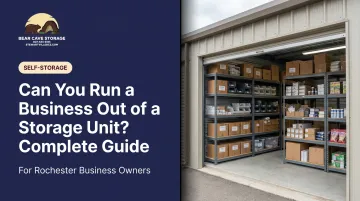
The honest answer is: yes and no. You can absolutely use a storage unit to support your business — storing inventory, tools, and equipment is widely done and generally permitted. But operating a business directly from a unit (meeting clients, making sales, staffing it daily) runs into real legal and lease-based restrictions that can get you evicted and uninsured.
This guide covers what's actually allowed, which business types benefit most, what Minnesota law says about it, and how to set up your unit for maximum business value.
Key Takeaways
- Storing inventory, equipment, or supplies in a storage unit for your business is generally permitted and widely practiced.
- Operating a customer-facing business from a unit is typically prohibited by both zoning law and facility lease terms.
- E-commerce sellers, contractors, event planners, and seasonal businesses benefit most from business storage.
- Rochester's zoning code prohibits sales, staffed operations, and any non-storage activity inside self-storage units.
- Month-to-month flexibility is the single strongest advantage over traditional commercial leases.
What "Running a Business Out of a Storage Unit" Really Means
There's a meaningful difference between operating from a storage unit and being supported by one. Most legitimate business uses involve managing physical assets — not conducting transactions or meeting customers on-site.
Picture two scenarios: a landscaper storing equipment through winter versus someone setting up a retail storefront inside a unit and inviting walk-in customers. One is a standard storage arrangement. The other creates real legal and safety problems — which is exactly what the rules are designed to prevent.
The Building Code Reality
The 2024 International Building Code classifies self-service storage facilities as Group S-1 Moderate-Hazard Storage. That's a fundamentally different occupancy classification than business or retail use. When you start conducting active commercial operations inside a storage unit, you're potentially creating a code violation — not just a lease issue.
What Rochester's Zoning Code Actually Says
Rochester's 2024 zoning materials are unusually direct on this point: the city defines mini-warehouse/public storage facilities as individual self-storage units for rent, and states that "the conduct of sales, business, or any activity other than storage shall be prohibited."
If you're in the Rochester or Stewartville area, that settles it: the unit holds your inventory or equipment; your business activity happens elsewhere.
What You Can (and Cannot) Do in a Storage Unit
You CAN Do This
- Store inventory and products — boxes, merchandise, packaging materials, seasonal stock
- Store tools and equipment between jobs — contractor gear, landscaping supplies, trade materials
- Organize and audit your stock — taking inventory, sorting, and labeling while you're on-site
- Accept occasional package deliveries — though confirm this with your facility first
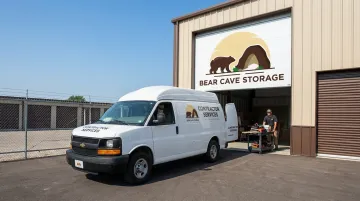
- Store a work vehicle — Bear Cave Storage offers both indoor and outdoor options for contractor vans, trucks, and commercial vehicles
You CANNOT Do This
- Host clients or customers inside the unit
- Run machinery, power tools, or production equipment
- Conduct repairs, manufacturing, or finishing work
- Use the unit as a registered business address — more on this below
- Hire employees to work inside the unit daily
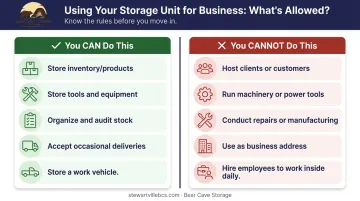
Storage facilities are zoned for storage, not occupancy. Fire codes and insurance requirements assume the space holds goods — not people working inside it. Violating lease terms can result in immediate eviction and void any storage coverage you've added.
The Gray Zone
Some activities vary by facility:
- Packing and shipping orders on-site
- Bringing a helper to load or unload
- Receiving freight deliveries at the gate
Always confirm these with your facility manager before assuming they're permitted.
Types of Businesses That Thrive With Storage Unit Support
E-Commerce and Online Sellers
Online retailers use storage units to hold product inventory, packaging materials, and seasonal stock — keeping their home clear without paying warehouse rates. A 10x10 or 10x20 unit handles modest inventory volume well. According to StorageCafe, retailers storing merchandise are one of the most common business-use cases in the self-storage industry.
The key advantage: you buy inventory in bulk, store it properly, and fulfill orders from home — the unit just holds your stock.
Contractors and Tradespeople
Landscapers, electricians, plumbers, and general contractors rely on drive-up storage units as a centralized equipment base. Tools, materials, and equipment need a centralized, secure home base between jobs — and hauling everything home nightly isn't practical.
Bear Cave Storage offers drive-up access across all indoor unit sizes (10x10 through 10x30) and outdoor fenced spaces with 24-hour drive-in access. The indoor vehicle storage option with a 14-foot overhead door works well for contractor vans and trucks too.
Event Planners and Seasonal Businesses
Tables, linens, tents, signage, holiday merchandise, and summer/winter gear don't need to live somewhere expensive year-round. A storage unit handles seasonal overflow at a fraction of the cost of permanent commercial space.
Artists, Crafters, and Makers
Finished goods, bulk supplies, and shipping materials can legally live in a storage unit as overflow from a home studio. What can't happen: using the unit itself as the production workspace.
Businesses That Run Into Trouble
Not every business model fits — some operations almost always run into lease violations or local ordinance issues:
- Auto repair or detailing
- Food prep or catering storage (health codes often apply — check local regulations)
- Beauty or wellness services that require client visits
- Operations using hazardous materials or requiring ventilation
- Businesses expecting regular customer traffic
Key Benefits for Small Business Owners
Cost and Flexibility
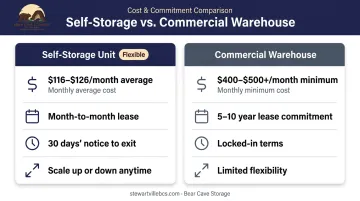
The national average for a 10x10 non-climate-controlled unit ran $126/month in April 2026, according to RentCafe. In St. Paul, MN, the comparable figure was $116/month. Compare that to industrial listings in the Rochester area, which currently show asking rents around $10–$12 per square foot annually — meaning even a modest 500 sq. ft. warehouse space runs $400–$500/month minimum, often on a multi-year lease.
That lease length gap is where storage has a clear edge. Per the Self Storage Association, virtually all self-storage rentals are month-to-month, terminable with 30 days' written notice. Industrial warehouse leases, by contrast, typically run 5 to 10 years. For a startup or lean operation, that flexibility matters. You're not locked into space you might not need in six months.
Bear Cave Storage offers three rental tiers: month-to-month, 6-month (5% discount), and 12-month (10% discount). Businesses can start small and scale to a larger unit as needs grow, without renegotiating a commercial lease.
Security
Reputable facilities provide layered security that often exceeds a home garage or rented office. Bear Cave Storage offers:
- 24/7 digital video surveillance
- Gated access with controlled entry
- 24-hour tenant access — business owners get in whenever their schedule demands
That infrastructure matters when you're storing tools, merchandise, or equipment with real replacement value. Pair it with appropriate business insurance (covered below), and you've got meaningful protection against loss or theft.
Tax Considerations
If a storage unit is used exclusively or primarily for business purposes, the rental cost may qualify as a deductible business expense under the IRS ordinary-and-necessary standard. Report it under rent/lease expenses on Schedule C.
Keep in mind that the IRS doesn't specifically name "self-storage unit" as a deductible category. Consult a tax professional to confirm eligibility and ensure personal-use portions aren't included in the deduction.
Legal and Zoning Considerations Before You Start
Minnesota-Specific Rules
Minnesota Statutes define a self-service storage facility as real property designed and used to rent or lease individual storage space for storing and removing personal property. The law explicitly prohibits using a self-service storage facility for residential purposes — and local zoning rules treat business operations the same way.
Rochester's 2024 zoning ordinance goes further, explicitly prohibiting sales, business activity, or anything other than storage inside individual units. If you're in the Rochester/Stewartville area, check with the City of Rochester Planning & Zoning office for your specific situation.
Using a Storage Unit as a Business Address
That zoning reality extends to your registration paperwork, too. Minnesota's Secretary of State requires a registered office address for LLCs and corporations — a P.O. box alone is not acceptable, and no public SOS guidance confirms that a storage unit address qualifies. Most storage facilities also prohibit it in their lease terms.
Better alternatives:
- A registered agent service (a Minnesota resident or entity authorized to accept legal documents)
- A virtual mailbox with a real street address
- Your home address (common for sole proprietors and LLCs)
Business Insurance Requirements
Self-storage facilities generally do not insure the contents of your unit. Standard tenant protection plans and personal renters insurance cover personal property — not business inventory or commercial equipment.
If you're storing business assets, you need either a commercial property insurance policy or a business owner's policy (BOP) that explicitly covers goods stored off-site. Bear Cave Storage offers a Tenant Protection add-on — worth asking about for business use — but confirm what it covers and fill any gaps with your own commercial coverage.
Practical Tips for Using Your Storage Unit Effectively
A few practical habits make the difference between a storage unit that works for your business and one that creates more headaches than it solves.
Organization comes first. Shelving units, clearly labeled bins, and a basic inventory spreadsheet reduce errors and simplify any insurance claims. Set this up before you start filling the space.
Match the unit to what you're storing. Bear Cave Storage offers drive-up access on units from 10x20 through 10x30, along with fenced outdoor spaces — both practical options for contractors or anyone moving heavy equipment in and out regularly. If you're storing electronics, paper documents, or fabric, call (507) 533-6185 to confirm unit conditions before committing.
Build your customer-facing presence online. Since a storage facility can't serve as your business address or customer location, invest in:
- A professional website
- A Google Business Profile (using your actual registered address)
- Social media and online marketplaces
- A virtual mailbox or registered agent for formal correspondence
This keeps your business visible and credible without requiring a commercial storefront.
Frequently Asked Questions
Frequently Asked Questions
Do people run businesses out of storage units?
Many small business owners use storage units to support their operations — for inventory storage, equipment management, and order fulfillment prep. Actually operating a customer-facing business inside a unit is generally restricted by lease terms and local zoning, but using storage as operational support is common and widely accepted.
Is it legal to use a storage unit as a business address in Minnesota?
Typically no. Most facilities prohibit it in their lease, and Minnesota's Secretary of State requires a physical registered office address — not a P.O. box and not a storage unit. Use a registered agent, virtual mailbox, or home address instead, and verify your specific situation with the facility.
Can you use a storage unit for e-commerce inventory storage?
Yes — this is one of the most common and straightforward legal uses. Online sellers store products, packaging, and supplies in storage units regularly. Whether you can also pack orders on-site varies by facility; confirm with your specific location before doing so.
What can't you do in a storage unit for business purposes?
The main prohibited activities: meeting or selling to customers inside the unit, running machinery or power tools, conducting repairs or manufacturing, and using the unit as a daily staffed workspace. These activities violate lease terms and zoning rules at most facilities, including in Rochester, MN.
Can you deduct a storage unit rental as a business expense?
If the unit is used exclusively or primarily for business, the rental cost is likely tax-deductible as a business expense. Don't deduct any personal-use portion, and confirm the details with a tax professional.
What size storage unit does a small business typically need?
It depends on your inventory volume and equipment. A general guide:
- 10x10 — modest e-commerce stock or contractor hand tools
- 10x20 — the most versatile option; fits contractor equipment, mid-volume inventory, or commercial vehicle storage
- 10x24, 10x30, or 20x40 (available at Bear Cave Storage) — heavier equipment loads, bulk inventory, or businesses with seasonal surges