Key Takeaways
- Drain all water from the engine, bilge, and livewells before temperatures drop below freezing
- Change the oil, fog the cylinders, and fill the tank with stabilized fuel before storage
- Clean and dry all surfaces, then protect aluminum tubes with marine wax or aluminum protectant
- Remove electronics, life jackets, and any organic materials that could attract pests or trap moisture
- Cover the boat with a vented winter cover and store it on a trailer or storage blocks in a secure, dry location
Why Pre-Storage Prep Matters for Minnesota Pontoon Owners
The last pontoon outing of the season always feels a little bittersweet. The cooler comes off the dock, ropes get coiled, and suddenly the boat is sitting in the driveway waiting for you to decide what happens next.
What happens next matters more than most owners realize.
According to Minnesota DNR freeze probability data, Rochester has a 50% chance of hitting 32°F by October 6 — with hard freezes at 28°F arriving by mid-October. That's not a lot of runway. Boats left unprepared when those temperatures hit face a predictable set of problems:
- Cracked gearcases and damaged engine internals from trapped water expanding as it freezes
- Corroded aluminum on pontoon tubes from months of sitting with waterline grime
- Mold-damaged upholstery from moisture sealed under an unsupported cover
- Dead batteries that won't recover after a winter of sitting discharged
The good news: a thorough prep session takes 3–6 hours for most DIY owners and protects a boat worth $15,000–$50,000 or more. Each section below covers one phase of the process, starting with the engine and working through to cover and storage.
Mechanical and Engine Prep Before Storage
Get the mechanical work done first, before the boat is cleaned or covered. This is where freeze damage actually happens.
Drain All Water Systems
Any water left in the engine block, lower unit, bilge, livewells, or ballast tanks can freeze and expand. According to USGS water density data, ice is approximately 9% less dense than liquid water — that expansion pressure in a confined space is what cracks gearcases and splits hoses.
Start by flushing and draining the cooling system, then work through every water-holding component:
- Flush and drain the engine cooling system completely
- Drain the lower unit, then inspect and replace gear lube before storage
- Clear the bilge, livewells, and any ballast tanks
- Store the outboard trimmed down and vertical so remaining water drains out rather than pooling inside the engine
Fuel System
Don't skip this step, and don't drain the tank dry. The correct approach:
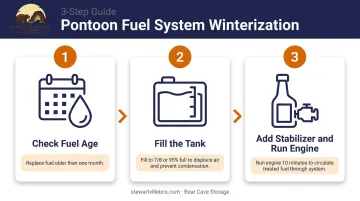
- Check fuel age — Mercury recommends replacing fuel that's more than one month old before storage. Start with fresh fuel.
- Fill the tank — Yamaha recommends storing at 7/8 full; Mercury advises about 95% full for older vented tanks. Check your engine OEM's guidance. Either way, the goal is displacing the air that causes condensation and rust inside the tank.
- Add a marine fuel stabilizer and run the engine for 10 minutes so treated fuel circulates through the entire fuel system, including the carburetor or injectors.
Don't cap or plug the tank vent — that causes its own problems.
Engine Oil, Fogging, and Gear Lube
Change the oil before storage, not in spring. Mercury's guidance is clear: used oil contains acidic combustion byproducts that can corrode bearings and internal surfaces over months of sitting. Four-stroke outboard oil and filter should be changed every 100 hours or once per season — fall is the right time.
Fogging protects cylinder walls and valves from moisture and combustion acids during the off-season:
- Warm the engine, then shut it off
- Remove spark plugs and spray fogging oil into each cylinder
- Reinstall with new plugs
- For DFI two-stroke engines, follow the manufacturer-specific procedure — fogging oil isn't the same process on every engine type
Yamaha's EFI engine storage fogging oil is rated to protect for up to one year of storage, well beyond Minnesota's typical 5–6 month off-season.
Battery
A discharged lead-acid battery can freeze at 32°F. A fully charged one resists freezing to well below -70°F, according to Crown Battery's marine storage guidance.
Three storage options, ranked:
- Remove the battery, store it indoors in a climate-stable space, and keep it on a trickle/float charger — this is the safest approach for Minnesota winters
- Disconnect the negative cable and confirm the battery is at full charge (12.6–12.8V for most lead-acid and AGM types, per OPTIMA's storage guidance) before leaving it in the boat
- Leaving it connected with parasitic loads slowly draining it over winter — avoid this entirely
A battery that sits discharged through a Minnesota winter often won't recover.
Cleaning, Inspecting, and Protecting Your Pontoon
Cleaning before storage isn't just about keeping the boat looking nice. Stains, algae, and organic debris left on surfaces for five or six months become significantly harder — sometimes impossible — to fully remove by spring.
Deck, Upholstery, and Carpet
Work through the interior systematically:
- Scrub vinyl upholstery with a marine-safe vinyl cleaner; rinse thoroughly and let it dry completely
- Vacuum carpet, then hose it out if needed — dry it fully before covering
- Wipe down all hard surfaces, including railings, console, and furniture frames
- Place rodent deterrent pouches or traps on the deck before sealing the cover. Mice commonly nest inside stored boats through Minnesota winters, and the damage they do to wiring and upholstery is substantial
Aluminum Pontoon Tubes
The toons take the most abuse all season — waterline scum, algae, mineral deposits, and general grime. Scrub them clean using a product designed for aluminum and pontoon surfaces. Meguiar's Marine/RV line includes a Pontoon Series Aluminum Cleaner and a separate Aluminum Protectant, which together handle both cleaning and sealing the surface against winter oxidation.
Apply the protectant or a marine wax to bare, clean aluminum before covering. Tubes left dirty through winter can develop surface corrosion that weakens the material at welds over time.
Electronics and Removable Gear
Pull everything that isn't built-in:
- GPS units, fish finders, depth finders, and portable stereos
- Life jackets, ropes, dock lines, and fenders
- Food, beverages, coolers, and any fabric items
- Seat cushions if they're removable
Extreme cold and moisture can permanently damage screens and circuit boards. Store electronics indoors in a temperature-controlled space. Everything else should come off to eliminate moisture traps and remove anything that attracts pests.
Boat Cover Selection
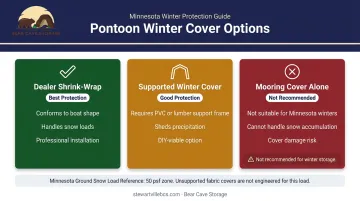
Once the boat is clean and gear is removed, the cover is your last line of defense for the winter. Summer mooring covers and winter storage covers serve completely different purposes — a mooring cover keeps rain and spray out while the boat is on the water, but it isn't built to handle months of Olmsted County winters.
Minnesota's snow-load map places southern Minnesota in the 50 psf ground snow load zone, which translates to roughly 35 psf on a roof-equivalent surface. An unsupported cover won't handle that — it'll sag, collapse, and trap moisture directly against your upholstery.
Cover options for Minnesota storage:
- Dealer shrink-wrap — Harris Boats recommends this as the best method for winter protection; it conforms to the boat's shape, locks out moisture, and handles snow loads well
- Supported winter cover — A heavy-duty cover stretched over a simple PVC or lumber ridge frame that sheds precipitation rather than collecting it; commercial cover support kits are available specifically for pontoons
- Mooring cover alone — Not suitable for outdoor winter storage in this climate
Proper Support and Choosing a Storage Location
Pontoon tubes should never rest directly on bare ground. Soil contact creates a moisture environment that accelerates corrosion on aluminum, and there's no way to keep the weight distributed evenly without it.
Store on the trailer or on purpose-built pontoon storage blocks that distribute weight evenly along the length of each tube. Follow your owner's manual or the storage facility's procedures for stand and support placement.
Indoor vs. Outdoor Storage
| Option | Protection Level | Typical Cost (Rochester Area) | Best For |
|---|---|---|---|
| Enclosed indoor | Maximum — UV, weather, pests, freeze-thaw | ~$200/month | Best all-around option |
| Outdoor fenced | Good with proper cover | From ~$41–$65/month | Budget-conscious owners with solid cover |
| Home garage/barn | Maximum if space allows | Cost of space you own | Owners with sufficient clearance |
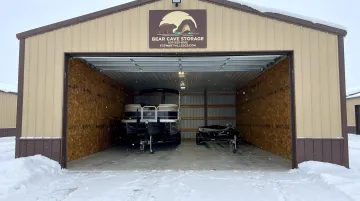
For Rochester and Stewartville boat owners without sufficient home storage, Bear Cave Storage offers both options. Outdoor fenced storage starts at $58.50/month on a 12-month plan, with 24/7 gated access and a well-maintained lot.
Enclosed indoor storage runs $200/month with a 14-foot overhead door and full weather protection. That's the better bet for any boat going through a full Minnesota winter.
Rentals are available month-to-month or on longer terms, and the facility can be reached at (507) 533-6185 or at sales@bearcavestorage.com.
Before You Drop a Boat at Any Storage Facility
Confirm these before committing:
- Unit or space dimensions will accommodate your boat and trailer together
- Facility allows mid-season access if you need to check on the boat or swap gear
- Security measures include fencing, lighting, and access controls
- Surface is level and well-drained — not a low spot that collects meltwater
End-of-Season Prep Timeline and Checklist
Start prep as soon as the last trip is done. Rochester has a 10% probability of hitting 32°F as early as September 22, and a 50% probability by October 6. Waiting until late October leaves little margin if an early freeze hits.
The full prep sequence, in order:
On the water / at the ramp:
- Trim outboard down, drain engine cooling water while running
- Drain bilge, livewells, and ballast tanks completely
At home or at the marina:
- Inspect and replace lower-unit gear lube
- Pump out old fuel if over one month old; refill to 7/8 or 95% full
- Add fuel stabilizer; run engine 10 minutes to circulate
- Change engine oil and filter
- Fog cylinders; install new spark plugs
- Fully charge battery; remove and store indoors or connect to float charger
- Scrub deck, upholstery, and carpet; dry completely
- Clean and treat aluminum pontoon tubes with protectant
- Remove all electronics, gear, life jackets, food, and fabric items
- Place rodent deterrents on the deck
- Install trailer or storage blocks for proper tube support
- Build or install cover support frame
- Fit winter cover or arrange shrink-wrap
In storage:
- Confirm unit/space dimensions fit boat and trailer
- Verify facility security and access arrangements
- Note storage start date; plan spring pickup before April 30 freeze risk window
Most owners doing this themselves will spend 3–6 hours on the full sequence. Marine dealers also offer winterization services if you'd prefer to hand that work off. Westre's Marine in St. Cloud, for example, lists Minnesota pontoon winterization, storage, and spring startup packages starting around $980 for outboards up to 20 feet.
Frequently Asked Questions
Frequently Asked Questions
How much does it cost to store a pontoon boat?
In the Rochester area, SpareFoot's Rochester boat storage listings show prices starting from $41/month, with 30-foot spaces averaging around $99/month. Bear Cave Storage's outdoor fenced storage starts at $58.50/month on an annual plan; enclosed indoor storage runs $200/month.
Where do people store pontoon boats?
The main options are home garage or barn, marina dry storage, self-storage facilities that accept large recreational vehicles, and outdoor storage on the owner's property. For Minnesota winters, enclosed indoor storage provides the best protection — outdoor storage works with the right cover system and a proper support setup.
When should I start preparing my pontoon for winter storage?
Start as soon as the last trip of the season is done. In Rochester, aim to complete all prep before early October — that's when freeze probability reaches 50%. Waiting until late October risks a hard freeze catching water still in the engine or lower unit.
Do I need to winterize my pontoon boat engine before storage?
Yes. Oil change, cylinder fogging, fuel stabilization, gear-lube inspection, and complete water drainage are all required steps — skipping any of them is one of the most common causes of cracked gearcases and corroded internals come spring.
Can I store a pontoon boat outside in winter?
Outdoor storage works, but only with a properly supported winter cover that can shed snow loads, a level and well-drained surface, and correct tube support. A summer mooring cover alone won't handle Minnesota snow accumulation. Indoor storage is the better choice wherever it's available.
Should I fill or drain the fuel tank before storing my pontoon boat?
Fill it — leave about an inch of headspace and add a marine fuel stabilizer. A nearly full tank displaces the air that causes condensation and internal rust; run the engine briefly after adding stabilizer so treated fuel reaches the entire system.