What most owners don't realize is that the storage process itself often causes more damage than winter driving would have. A dead battery is just the beginning. Degraded fuel, fused brake pads, flat-spotted tires, and mouse nests in the wiring harness are all real outcomes of improper storage — and they're entirely preventable.
This guide covers exactly what to do (and what to skip) before your vehicle sits for a Minnesota winter. Mechanical prep, exterior protection, choosing the right environment, common mistakes, and the spring de-storage checklist — all here.
Key Takeaways
- Change your oil, fill the tank with stabilizer, and verify your coolant's freeze point before storing — not after
- Use a breathable car cover, chock the wheels instead of using the parking brake, and connect a battery maintainer
- Choose enclosed, dry storage that protects against moisture, temperature swings, and pests
- Don't start the car for brief warm-ups — short idle sessions do more harm than good without reaching full operating temperature
- Don't skip the spring checklist — check tires, remove exhaust blockages, and inspect for rodent damage before your first drive
The Do's: Mechanical and Fluid Preparation
Change the Oil Before You Store
Used engine oil carries combustion byproducts, moisture, and acidic contaminants from normal operation. Left sitting in a stored engine for four to six months, those contaminants corrode internal components and promote sludge buildup. Hagerty recommends changing oil before storage if the car will sit longer than 30 days — even if you're not at your usual service interval yet.
Change the filter at the same time, and you've protected one of the most expensive components on the car.
Fuel Management: Fill Up and Stabilize
An empty tank is a moisture trap. A full tank minimizes the air space where condensation forms — and it protects seals and gaskets from drying out.
Add fuel stabilizer before filling up, then drive 5–10 miles to circulate it through the system. Here's why this matters for Minnesota owners specifically:
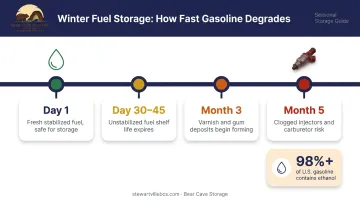
- According to AAA Northeast, gasoline has a shelf life of just 30–45 days
- The Department of Energy confirms that more than 98% of U.S. gasoline contains ethanol — E10 is the standard blend at most Minnesota pumps
- Ethanol-blended fuel degrades faster, leaving behind varnish and gum deposits that clog fuel injectors and carburetors
A car sitting from November to April — roughly 5 months — will see degraded fuel without stabilizer. Skip this step and you risk a gummed-up fuel system that needs professional cleaning before the car will run properly in spring.
Coolant Freeze Point
Don't assume your coolant is fine because it was topped off last spring. A standard 50/50 antifreeze-to-water mix protects down to -34°F, which covers even a severe Rochester winter. But the mix can drift over time.
Check your freeze point with a hydrometer or test strips before storage. Don't mix coolant formulations — stick with whatever type your vehicle requires.
Battery Care
Two approaches work for winter storage:
- Battery maintainer (preferred for newer vehicles): A microprocessor-controlled maintainer with auto-shutoff keeps the battery at the correct charge level without overcharging. OPTIMA recommends keeping lead-acid batteries above 12.4 volts during storage.
- Disconnect the negative cable: Works fine for older vehicles without complex electronics, but can reset computer settings on newer cars.
Don't use a basic trickle charger without auto-shutoff. Sustained overcharging damages battery cells and can shorten battery life significantly.
Lubrication
Before closing up for winter, work a silicone lubricant into:
- Door hinges and hood latches
- Door locks
- Rubber door and trunk seals
Cold storage causes rubber to stiffen and seals to crack. A light coat of silicone lubricant before storage keeps everything functioning when spring arrives.
The Do's: Exterior, Interior, and Tire Protection
Wash Before You Store — Including the Undercarriage
MnDOT applies chemicals to 12,000 miles of roadway each winter, and road salt residue left on the undercarriage will continue corroding metal throughout the storage period. Wash the car thoroughly — undercarriage included — before it goes into storage.
After washing:
- Dry the car completely before covering it
- Apply a coat of paste wax to protect the paint
- Use a breathable, custom-fit fabric car cover — not a plastic sheet (more on why in the Don'ts section)
Interior Prep and Pest Prevention
Rodents are a serious threat to stored vehicles. The NPMA identifies vehicle wiring, insulation, and upholstery as prime rodent targets, and a single mouse can cause hundreds of dollars in electrical damage.
Interior checklist:
- Vacuum thoroughly and remove any food wrappers or organic debris
- Condition leather surfaces
- Place desiccant moisture-absorbing packs inside the cabin (set them on a disposable tray — they can stain upholstery)
Rodent deterrence:
- Block the exhaust pipe and air intake with steel wool or a clean rag — tag them visibly so you don't forget before starting
- Place peppermint-scented deterrents or dryer sheets inside the cabin
- Set mouse traps around the vehicle, not inside it
No single deterrent is foolproof — combining three or more methods gives you meaningfully better odds than relying on any one alone.
Tire Care
Cold temperatures stiffen rubber compounds, increasing the risk of flat-spotting — where tires deform under the vehicle's weight at the contact point with the ground. Rochester winters regularly drop below 0°F, which accelerates this process.
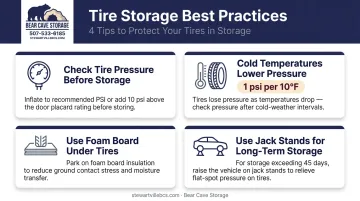
- Inflate tires to the recommended PSI, or add 10 psi above the door placard recommendation for storage
- Tires lose approximately 1 psi per 10°F temperature drop — a fact NHTSA reinforces in its tire safety guidance
- Parking on foam board insulation reduces ground contact stress
- For storage exceeding 45 days, AAA recommends placing the vehicle on jack stands to eliminate flat-spot risk entirely
Skip the Parking Brake
Leave the parking brake off during long-term storage. Brake pads and shoes can fuse to rotors and drums over months of inactivity. Use wheel chocks instead to keep the car stationary.
Choosing the Right Storage Environment
The ideal storage space is enclosed, dry, and ventilated — with a concrete floor and no ground moisture seeping up. If storing on bare concrete, place a plastic vapor barrier under the vehicle to prevent moisture from attacking the undercarriage.
Home Garage Limitations
Many home garages aren't as storage-ready as they look:
- Temperature swings between day and night accelerate moisture cycling
- Gaps around doors create pest entry points
- Poor ventilation traps humidity against paint and metal
Practical workarounds include sealing entry gaps with weather stripping, running a dehumidifier, and adding ventilation if airflow is restricted.
Dedicated Vehicle Storage
For owners without a suitable home garage, a dedicated vehicle storage facility is the most reliable option. Bear Cave Storage, serving Rochester and Stewartville, offers enclosed indoor storage units purpose-built for vehicle protection. Key features include:
- Unit sizes from 10x20 (fits most standard passenger cars and trucks) up to 20x40 for larger classics, RVs, or multiple vehicles
- 14-foot overhead door for easy drive-in access
- 24/7 gated security with surveillance monitoring
- Month-to-month or 6-month seasonal rentals, matching Minnesota's typical storage window
- Full online rental and payment available at any time
Outdoor Storage as a Last Resort
If enclosed storage isn't an option:
- Use a heavy-duty weatherproof cover rated for outdoor use
- Lay a plastic tarp on the ground beneath the vehicle to block moisture
- Increase rodent deterrents significantly — outdoor-stored vehicles are more vulnerable
- Expect higher risk of paint degradation, moisture intrusion, and pest activity over a full Minnesota winter
Winter Car Storage Don'ts
Don't Skip the Pre-Storage Oil Change
Used oil doesn't just sit inert — it slowly corrodes engine components during months of inactivity. This is one of the most commonly skipped steps, and one of the most damaging. If the oil is more than 1,000 miles from its next change, do it before storage, not after.
Don't Start the Car for Brief Warm-Ups
This one surprises people. Short idling sessions — 5 to 10 minutes — introduce condensation into the engine and exhaust without reaching the operating temperature needed to burn it off. The result is accelerated internal rust.
Hagerty is direct on this: don't start the car unless you can drive it on the road for at least 20 minutes — long enough to bring the engine, oil, and exhaust fully up to operating temperature. If you can't do that, don't start it at all.
Don't Use a Plastic Cover
Plastic traps moisture against the paint surface, creating exactly the corrosive environment you're trying to prevent. A loose universal cover is almost as bad — it allows abrasive dust particles to shift under the material and scratch the finish.
Always use a breathable, fitted fabric cover designed for automotive storage.
Don't Leave the Tank Empty or Skip Stabilizer
An empty tank invites moisture condensation and dries out fuel system seals. Unstabilized ethanol-blended fuel degrades into varnish deposits that clog injectors — often requiring professional cleaning before the engine runs cleanly again.
Fill the tank, add stabilizer, and drive it briefly to circulate the treated fuel. That 10-minute task prevents a costly spring repair.
Don't Let Your Insurance Lapse
Mechanical prep covers most risks — but not all of them. A stored vehicle remains exposed to fire, theft, falling objects, and flooding. State Farm and Progressive both recommend maintaining comprehensive coverage (while suspending liability and collision) during storage — it's typically inexpensive and prevents a coverage gap that can affect your future insurance eligibility.
Taking Your Car Out of Winter Storage
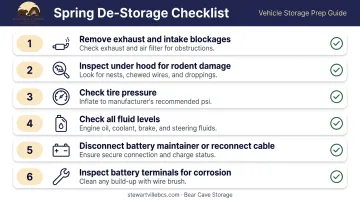
Before touching the ignition, run through this checklist:
- Remove all blockages — pull the steel wool or rags from the exhaust and air intake
- Inspect under the hood — look for rodent nesting, chewed wires, or disturbed insulation
- Check tire pressure — tires lose air over months, especially with temperature fluctuations
- Check fluid levels — oil, coolant, brake fluid, and power steering before starting
- Disconnect the battery maintainer (or reconnect the negative cable if you disconnected it)
- Inspect battery terminals for corrosion and verify charge before cranking
On the first start: let the engine reach full operating temperature before any sustained driving. Some unusual sounds from seals and brake surfaces are normal — they typically resolve within the first few minutes of movement. A gentle back-and-forth in the driveway helps clear light surface rust from the rotors.
That said, if noises don't resolve — or if you notice fluid leaks — have the vehicle inspected before driving it on the road.
Frequently Asked Questions
Frequently Asked Questions
How long can a car sit unused in winter?
With proper preparation (fuel stabilizer, battery maintainer, and fresh oil), a vehicle can safely sit through a full 4–6 month Minnesota winter. Without preparation, problems like dead batteries, degraded fuel, and flat-spotted tires can start within 30 days.
Should I start my car during winter storage?
Brief idling sessions do more harm than good. They introduce moisture without reaching the temperature needed to burn it off. If you do run the car, drive it for at least 20 minutes until the engine is fully warmed up.
Do I need to disconnect my car battery for winter storage?
A battery maintainer with auto-shutoff is the better option for newer vehicles, since it prevents drain without resetting engine computers. Disconnecting the negative cable works fine for older vehicles without sensitive electronics.
Is it safe to use a plastic tarp as a car cover?
No. Plastic traps moisture against the paint and accelerates rust and corrosion. Use a breathable, fitted fabric cover made for automotive storage.
What's the best way to keep mice out of a stored car?
Layer your defenses: block intake and exhaust openings with steel wool, place peppermint-based deterrents inside the cabin, and set mouse traps around (not inside) the vehicle. No single method is reliable on its own.
Can I leave the parking brake on during winter storage?
Don't. Leaving the parking brake engaged for months can cause brake pads or shoes to fuse to rotors or drums. Use wheel chocks instead.