This guide covers everything: how to choose the right unit type and size, how to prepare your car step by step, what documents you'll need, and the mistakes that turn a straightforward storage rental into an expensive repair bill. Whether you're storing a convertible through a Minnesota winter, parking a second vehicle while deployed, or dealing with HOA restrictions, the prep process is the same.
Key Takeaways
- Storing a car in self-storage is legal with valid registration, active insurance, and no fluid leaks
- A 10×20 unit fits most sedans and compact SUVs; larger vehicles need a 10×24 or 10×30 (confirm door width before booking)
- Prep is non-negotiable: fill the tank with stabilizer, change the oil, disconnect the battery, inflate tires, and cover with a breathable car cover
- Indoor enclosed storage offers the best protection for long-term or winter storage — especially relevant in Rochester and Stewartville, MN
When Should You Store a Car in Self-Storage?
Self-storage makes sense when a vehicle will sit unused for 30 days or more. Common situations include:
- Seasonal storage for a convertible, classic car, or second vehicle through winter
- Military deployment or extended travel abroad
- Life transitions — college, a cross-country move, or a temporary housing situation
- HOA parking restrictions that prohibit keeping certain vehicles on the property
Short-Term vs. Long-Term: Which Storage Type Fits?
For newer vehicles stored fewer than 30 days, open outdoor fenced storage is often sufficient and the most cost-effective option. For anything longer — particularly collector cars, luxury vehicles, or storage through a harsh Minnesota winter — enclosed indoor storage is the better investment.
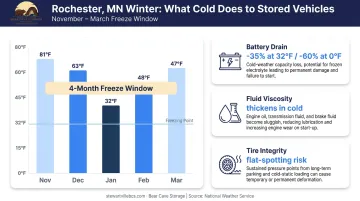
Rochester's climate makes that case clearly: according to the National Weather Service, Rochester averages 36 nights at or below 0°F per winter, with average highs staying at or below freezing from late November through early March. That's four months of conditions that drain batteries, thicken fluids, and accelerate tire flat-spotting.
Before committing to any storage option, verify what your facility allows. Most won't approve vehicles with active fluid leaks, missing registration, or no insurance coverage.
Choosing the Right Storage Unit for Your Car
Getting the unit type and size right upfront saves you from a car that won't fit through the door or takes unnecessary weather damage.
Indoor vs. Outdoor Storage
Bear Cave Storage offers two main vehicle storage options across their Rochester and Stewartville, MN locations:
| Type | Protection Level | Best For |
|---|---|---|
| Enclosed Indoor | Highest — sealed from weather, pests, temperature swings | Classic cars, long-term storage, winter storage |
| Outdoor Fenced | Security-focused — gated, surveilled, 24/7 access | Trucks, RVs, boats, short-term or budget storage |
For vehicles stored through a Minnesota winter, enclosed indoor storage is the practical choice. Cold temperatures reduce battery strength by roughly 35% at 32°F and 60% at 0°F, and enclosed units eliminate moisture accumulation, UV exposure, and rodent access that outdoor parking cannot fully prevent.
Their indoor shared spaces include a 14-foot overhead door for easy access to taller vehicles, with 24/7 security and gated entry across all locations.
What Size Unit Do You Need?
Here's a practical size guide based on vehicle type:
| Unit Size | Best For |
|---|---|
| 8×20 | Motorcycles, jet skis, smaller sedans |
| 10×20 | Most sedans, compact SUVs, standard cars |
| 10×24 | Full-size trucks, vans, vehicles with trailers |
| 10×30 | Large SUVs, RVs, multiple vehicles, oversized equipment |
| 20×40 | Extra-large boats, motorhomes, or multiple stored vehicles |
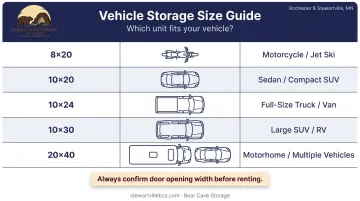
Bear Cave Storage offers all of these sizes as enclosed indoor units, with outdoor fenced options for cars, trucks, RVs, and trailers as well.
Critical tip: Always ask for the door opening width, not just the floor dimensions. A unit listed as 10 feet wide may have an 8- or 9-foot door opening that won't accommodate a truck with mirrors extended. Contact Bear Cave Storage at (507) 533-6185 to confirm exact door clearances before renting.
A Note on Climate Control
Bear Cave Storage does not offer climate-controlled units. Their enclosed indoor storage provides physical shelter from weather, which handles most cold-climate risks effectively. For the most sensitive classic cars or vehicles with custom leather interiors, a climate-controlled facility elsewhere may be worth comparing. For most vehicles stored in Minnesota, enclosed indoor protection is what actually matters.
How to Prepare Your Car for Storage
Improper prep is the top reason people return to a damaged vehicle. Each step below directly prevents a specific problem.
Step 1: Clean the Car Thoroughly
Wash and wax the exterior — road salt and grime eat into paint over months. If the car has been driven on salted Minnesota roads, clean the undercarriage specifically. Vacuum the interior completely and remove all food, organic material, and trash. Rodents don't need much invitation.
Apply a protective product to rubber door seals and vinyl trim to prevent cracking. Make sure the interior is fully dry before covering to prevent mold.
Step 2: Service the Engine and Fluids
Two fluid steps matter most:
- Fill the tank and add fuel stabilizer. Gasoline degrades in as little as 3–6 months, leaving gum-like residue in fuel lines. STA-BIL's storage formula keeps fuel fresh up to 24 months — use 1 oz per 2.5 gallons, fill to 95%, then run the engine for 5 minutes to circulate it.
- Change the oil before storage, not after. Contaminants in used oil corrode engine components when sitting stagnant — State Farm and Toyota both recommend this for any storage longer than a month.
Also top off coolant/antifreeze (critical in Minnesota), brake fluid, and windshield washer fluid.
Step 3: Handle the Battery
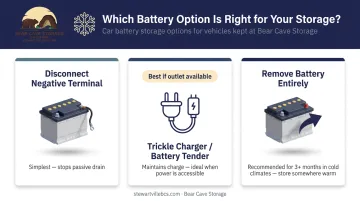
A car battery can die in as little as 4 weeks to 2 months when a vehicle sits unused — key-off systems like alarms, clocks, and computer memory drain it continuously. Cold makes this worse. Three options:
- Disconnect the negative terminal — stops passive drain, simplest approach
- Connect a trickle charger/battery tender — best option if your unit has an outlet; maintains charge without overcharging
- Remove the battery entirely — recommended for storage longer than 3 months in cold climates; store it somewhere warm
Step 4: Protect the Tires
Michelin notes that flat spotting can begin after just days or weeks of stationary storage, and cold temperatures make tires stiffer and more prone to permanent deformation. Two practical steps:
- Inflate tires to the manufacturer's recommended placard pressure (not beyond it)
- For storage longer than 30 days, use jack stands or tire cradles to relieve sustained pressure on one contact point
Step 5: Prevent Pests and Set the Brake Correctly
Rodents enter through the exhaust pipe and air intake. To block them:
- Plug both openings with steel wool — remove it before starting the car
- Place peppermint oil sachets or cayenne pepper in the cabin and trunk (Consumer Reports confirms these as reported deterrents)
The parking brake is a separate concern. Toyota, State Farm, and Edmunds all recommend releasing it for long-term storage — brake pads can fuse to rotors over months. Use wheel chocks behind the rear tires instead.
Step 6: Cover the Vehicle
Use a breathable, soft-fabric car cover sized for your vehicle. State Farm recommends breathable fabric specifically — plastic tarps trap moisture against paint. Before covering:
- Close all windows
- Remove valuables
- Retract or remove the antenna
What You Need Before Moving In
Most facilities require documentation before approving vehicle storage — arriving unprepared will delay the process.
Required Documents and Vehicle Conditions
Standard requirements across most major facilities include:
- Valid government-issued photo ID
- Current vehicle registration
- Proof of active auto insurance
- Vehicle in operable condition with no active fluid leaks
Per U-Haul and Extra Space Storage, vehicles must remain registered and insured throughout the rental period — not just at move-in. Bear Cave Storage lets you reserve a unit online 24/7, so you can confirm availability and sort out paperwork before you show up.
Insurance Considerations
Most facilities require proof of active insurance. If your car will sit unused for 30+ days, ask your insurer about adjusting coverage. Allstate notes that some drivers may be able to suspend liability and collision while keeping comprehensive coverage, which protects against theft, fire, and weather damage. Progressive confirms there's no dedicated "storage insurance" — comprehensive is the closest option.
One caveat: if your vehicle is financed or leased, your lender likely requires you to maintain both comprehensive and collision regardless.
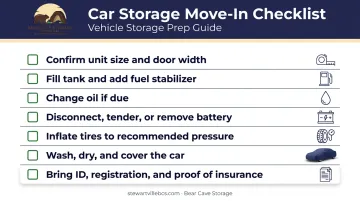
With documentation and insurance sorted, the final step is making sure your car is physically ready. Run through this checklist before driving to the facility:
Move-In Checklist
- Confirm unit size and verify door width fits your vehicle
- Fill the tank and add fuel stabilizer
- Change the oil if due within the storage period
- Disconnect, tender, or remove the battery
- Inflate tires to recommended pressure
- Wash, dry, and cover the car
- Bring photo ID, registration, and proof of insurance
Common Mistakes When Storing a Car in Self-Storage
Most car storage problems don't happen during storage — they happen because of skipped prep. These three mistakes show up repeatedly.
Old fluids and a half-empty tank. Contaminants in used oil corrode internal engine components during long inactivity. A partially empty gas tank accumulates condensation that rusts the fuel system. Neither issue is visible until you try to start the car months later.
Under-inflated tires and an engaged parking brake. Stationary cars develop flat spots on tires, and Michelin notes cold temperatures make this worse. Leave the parking brake engaged for months and you risk fused brake pads. Both problems are avoidable with five minutes of prep before drop-off.
Reserving a unit without confirming door clearance. Renters sometimes choose the cheapest outdoor spot without accounting for a Minnesota winter, or reserve a unit based on floor dimensions alone. A 10-foot-wide unit doesn't guarantee a 10-foot-wide door opening — always confirm the actual clearance before signing.
Frequently Asked Questions
Can you legally store a car in a storage unit?
Yes — storing a registered, insured passenger vehicle in a self-storage unit is legal. Most facilities require proof of current registration and active insurance before approving vehicle storage. In Minnesota, self-storage facilities are legally defined as places to store personal property, which includes vehicles.
What size storage unit do I need for a car?
A 10×20 unit fits most standard sedans and compact SUVs. Full-size trucks, vans, or vehicles needing extra room to open doors typically need a 10×24 or 10×30. Always verify the door opening width with the facility before renting — floor dimensions and door clearance are often different.
How long can you store a car in a self-storage unit?
Cars can be stored for months or even years, provided the rental agreement stays active, insurance remains valid, and the vehicle is properly prepared. The longer the storage period, the more thorough the prep — especially for the battery, fuel system, and tires.
Do I need insurance to store my car in self-storage?
Most facilities require proof of active auto insurance at move-in. If the car won't be driven, ask your insurer about a comprehensive-only policy, which covers theft, fire, and weather damage at a lower premium than full coverage. Check with your lender first if the vehicle is financed.
Should I start my car while it's in storage?
Running the engine for 10–15 minutes periodically helps circulate fluids and maintain battery charge. Don't idle inside a sealed unit — move the car outside before starting it, since exhaust fumes build up quickly in enclosed spaces.
Is indoor or outdoor storage better for a car?
Enclosed storage is the better choice for most cars, especially in cold climates or for long-term storage. It protects against temperature extremes, moisture, UV exposure, and pests. Outdoor fenced storage works well for shorter-term storage or for owners comfortable with seasonal exposure.