Rochester averages 48.1 inches of snow annually and 163.6 days per year with lows at or below freezing. Add road salt into the equation — Minnesota applies hundreds of thousands of tons annually — and the case for protecting your vehicle becomes financial, not just practical.
This guide breaks down exactly what indoor and outdoor storage offer, what each costs, and how to choose based on your vehicle, budget, and how long it'll sit.
Key Takeaways
- Indoor storage provides full weather protection and higher security — best for high-value, long-term, or weather-sensitive vehicles.
- Outdoor storage is the most affordable option, well-suited for durable vehicles used frequently throughout the season.
- Covered storage (canopies/carports) offers rain and UV protection at a mid-range price point — a solid middle ground.
- The right choice comes down to three things: vehicle value, storage duration, and budget.
- In Minnesota, cold exposure carries real repair costs. The stakes are higher here than in mild-climate states.
Indoor vs. Outdoor Vehicle Storage: Quick Comparison
No single option is universally better. Use this table as a starting point to identify which tier fits your situation.
| Feature | Outdoor | Covered | Indoor |
|---|---|---|---|
| Weather Protection | None | Partial (rain, UV) | Full (all elements) |
| Security Level | Gated lot | Gated lot | Gated + locked unit |
| Monthly Cost | Lowest | Mid-range | Highest |
| Accessibility | 24/7 drive-in | 24/7 drive-in | 24/7 drive-in |
| Best For | Large vehicles used often, tight budgets | Boats, RVs, trucks needing basic shelter | Classic cars, motorcycles, long-term storage |
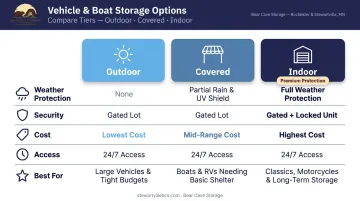
Covered storage is a distinct middle tier, not just a step down from indoor. If you need more than a gated lot but can't justify full enclosed rates, ask any facility whether they offer it — not all advertise it prominently.
What Is Indoor Vehicle Storage?
Indoor vehicle storage means a fully enclosed unit or bay — four walls, a roof, and a locked door. Your vehicle is shielded from weather, UV rays, dust, and unauthorized access on all sides.
Types of Indoor Storage
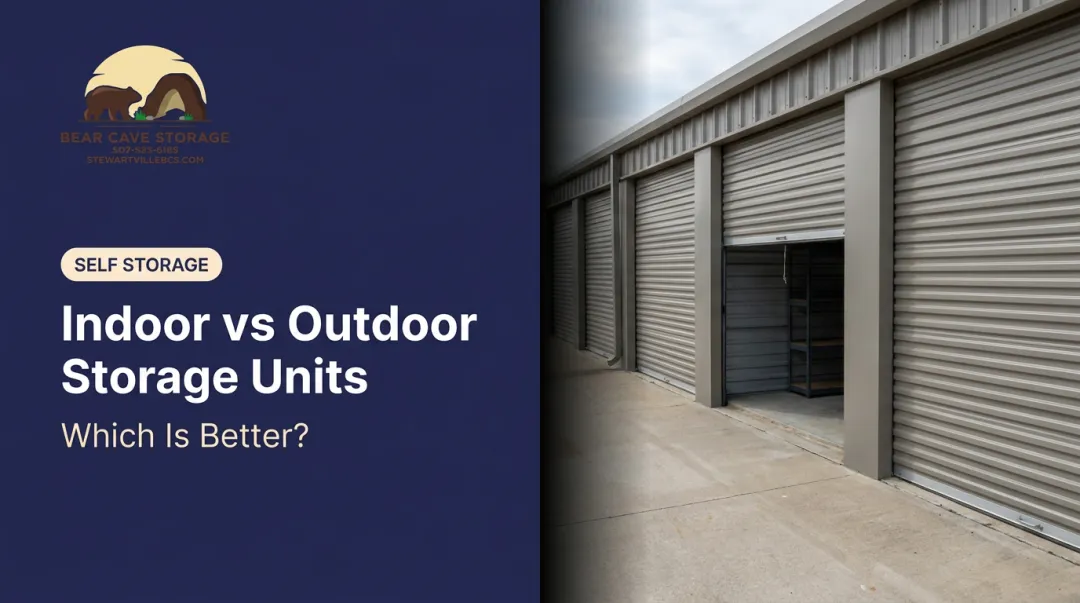
- Standard enclosed units — Drive-up bays with a roll-up door, no temperature control. The most common option for cars, motorcycles, and boats.
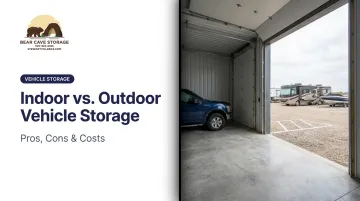
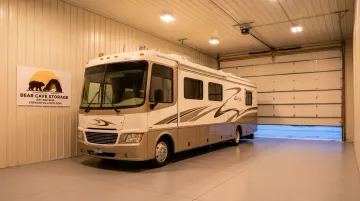
- Shared indoor bays — A larger, shared enclosed space with a tall overhead door for oversized vehicles. Bear Cave Storage's Indoor Storage (Shared) option uses a 14-foot overhead door — tall enough for RVs, campers, boats, and fifth-wheel trailers.
Why It Matters in Minnesota
Rochester's winter lows hit an average of 6°F in January according to NOAA's 1991–2020 climate normals. Enclosed storage blocks the direct effects: no snow accumulating on a boat cover, no UV degrading a convertible top, no freeze-thaw cycling cracking rubber seals on an RV's water lines.
Road salt is the other factor. AAA estimates de-icer-related rust repairs cost U.S. drivers more than $3 billion annually, with the average repair running $490. Salt doesn't just attack vehicles on the road — it gets tracked into storage areas and clings to undercarriages.
Security Features
Typical indoor facilities provide gated perimeter access, surveillance cameras, individual unit locks, and coded entry. Bear Cave Storage includes 24/7 gated security across all its indoor units, with drive-up access available around the clock.
Limitations to Know
- Higher monthly cost than outdoor options
- Unit size constraints — very large RVs may need a shared bay or outdoor space
- Standard enclosed units typically don't include climate control (check with the facility before assuming)
Best Vehicles for Indoor Storage
Indoor storage is the right call for:
- Classic and collector cars
- Motorcycles and convertibles
- Luxury vehicles
- Boats and watercraft not in active use
- Any vehicle stored for three or more consecutive months
What Is Outdoor Vehicle Storage?
Outdoor storage is an open-air, fenced lot where your vehicle parks without a roof or walls overhead. Quality facilities still include gated perimeters, coded access, and surveillance — the difference is exposure to the elements, not exposure to theft risk.
The Cost and Access Advantage
Outdoor spaces are consistently the most affordable option. At Bear Cave Storage, outdoor fenced storage runs $65.00/month on a month-to-month basis, dropping to $58.50/month with a 12-month prepay. For an RV or boat owner who uses their vehicle multiple times per season, that pricing — combined with 24/7 drive-in access — makes outdoor storage hard to beat on pure convenience.
What Outdoor Storage Leaves Your Vehicle Exposed To
This is the honest trade-off:
- Battery drain — Consumer Reports reports a battery has roughly half its cranking power at 0°F compared to 80°F. Sub-zero Minnesota winters can render a neglected battery useless by spring.
- Tire pressure loss — AAA notes tires can lose about 1 PSI for every 10°F temperature drop, causing flat spots and uneven wear over a long winter.
- Freeze-thaw damage — MnDOT's 2022 research found southern Minnesota has experienced roughly 10–20 additional freeze-thaw days per year over the past four decades. Each cycle stresses rubber seals, door gaskets, and caulked joints on RVs and boats.
- UV and weather degradation — Paint fading, cracked dashboards, and oxidized gelcoat are cumulative effects of months of sun, rain, and snow.
- Salt and road debris — Road salt picked up during trips in and out continues corroding undercarriages even after parking.
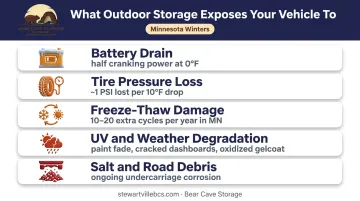
A quality car cover helps offset some of these risks, though it won't fully replace the protection that walls and a roof provide.
Best Use Cases for Outdoor Storage
- Large trucks and work vehicles used year-round
- Boats on trailers retrieved multiple times per season
- RVs stored for shorter stretches between camping trips
- Vehicles on tighter budgets where the owner actively manages prep and maintenance
How Much Does Vehicle Storage Cost?
The Three Cost Tiers
Pricing varies by facility, region, and vehicle size, but the general structure holds consistently:
| Storage Type | General Monthly Range (RV) | Bear Cave Storage Rate |
|---|---|---|
| Outdoor | $30–$150/mo | From $58.50/mo (12-mo prepay) |
| Covered | $50–$200/mo | Contact facility |
| Indoor/Enclosed | $100–$500/mo | From $143.10/mo (10x30, 12-mo prepay); $200/mo (shared bay) |
General ranges sourced from SpareFoot's RV storage cost guide. Bear Cave Storage rates are current facility pricing.
Size Determines Price
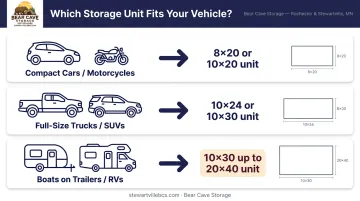
The larger the vehicle, the larger the unit required — and price scales accordingly:
- Compact cars / motorcycles — 8×20 or 10×20 unit
- Full-size trucks / SUVs — 10×24 or 10×30
- Boats on trailers / RVs — 10×30 up to 20×40 (or outdoor spaces sized at 14×40 equivalent and larger)
Bear Cave Storage's largest enclosed unit is the 20×40×10, suitable for big boats, RVs, and large trailers. The 10×30 unit at $159/month (month-to-month) or $143.10/month with a 12-month commitment covers most mid-size RVs and larger boats.
Additional Fees to Expect
Before signing any storage contract, ask about:
- Admin or setup fees typically run $10–$25 at most facilities
- Tenant protection or insurance plans add $10–$20/month and may be required
- Late payment fees vary — confirm the policy before signing
- Security deposits aren't universal; some facilities substitute an admin fee instead
Always review the full rental agreement before committing.
Saving on Storage Costs
- Prepay for 6 or 12 months — Bear Cave Storage offers 5% and 10% discounts respectively
- Compare what's included, not just the base rate — gated access, 24/7 entry, and security features have real value
- Right-size your unit — Paying for a 20×40 when a 10×30 fits your vehicle means paying for empty space every month
Which Storage Option Is Right for You?
The Three Questions to Answer First
1. How long will the vehicle be stored? Under two months? Outdoor is often fine with proper prep. Three months or more through a Minnesota winter — especially for boats, RVs, and classics — indoor protection starts paying for itself through avoided repairs.
2. What is the vehicle's value and weather sensitivity? A 10-year-old work truck handles outdoor storage without much risk. A restored classic car, a boat with a fiberglass hull, or any vehicle with significant resale value deserves better protection than an open lot in Rochester's January.
3. What is your monthly budget? Be honest here. A $65/month outdoor space that fits your budget beats an indoor unit you can't sustain. Pick the option you can commit to for the full storage period — gaps in coverage are where damage happens.
Minnesota-Specific Considerations
Once you've worked through those three questions, Minnesota's climate becomes the deciding factor for many owners. A few specifics worth knowing:
- Rochester has 35.6 nights per year at or below 0°F — well within the range where battery performance drops by half
- Southern Minnesota's repeated freeze-thaw cycles mean seal damage compounds across months — it's not a single winter event
- RVs left outdoors without winterizing risk freeze damage to water lines, p-traps, and toilets (Go RVing recommends RV-safe antifreeze throughout the plumbing system before any outdoor winter storage)
For Minnesota boat and RV owners storing over winter, the gap between outdoor ($58–$65/month) and enclosed indoor ($143–$200/month) at Bear Cave Storage is roughly $80–$140/month. A single de-icer-related rust repair averages $490. The math shifts toward indoor storage pretty quickly for multi-month storage.
When Covered Storage Is the Right Middle Ground
Covered storage (canopy or carport-style spaces) makes sense when:
- The vehicle is too large or expensive for fully open storage
- You want rain and UV protection without full indoor pricing
- The vehicle is used several times per season and needs easy pull-in/pull-out access
Conclusion
Indoor storage gives your vehicle the strongest protection from the elements. Outdoor storage keeps costs low and access flexible. Covered storage lands somewhere in between. The right choice comes down to your vehicle, your budget, and just how long you want Rochester's winter working against you.
For vehicle owners in the Rochester, Stewartville, Byron, Pine Island, and Racine areas, Bear Cave Storage offers both indoor enclosed units and outdoor fenced spaces built for exactly these conditions. Reach out at (507) 533-6185 or email sales@bearcavestorage.com to check availability and find the right fit for your vehicle.
Frequently Asked Questions
How much does it cost to store a 20-foot RV?
A 20-foot RV typically fits a 10×25 to 12×30 space. General national ranges run $74–$150/month for outdoor, $125–$250/month for covered, and $100–$500/month for indoor storage. At Bear Cave Storage, outdoor spaces start at $58.50/month (12-month prepay) and enclosed indoor options start around $143–$200/month depending on unit size.
Is indoor vehicle storage worth the extra cost?
For high-value, classic, or long-term-stored vehicles in cold climates, yes. AAA puts average de-icer rust repair costs at $490 per incident — one repair can wipe out months of savings from choosing cheaper outdoor storage.
What is the difference between covered and indoor vehicle storage?
Covered storage uses open-sided canopies or carport structures that shield from rain and sun but leave the sides open to wind and cold. Indoor storage is fully enclosed with walls and a locked door — offering complete weather protection, more privacy, and higher security at a higher monthly rate.
Can I store an RV or boat in an indoor storage unit?
Yes, but size and height clearances vary by facility. Bear Cave Storage's shared indoor bay features a 14-foot overhead door and accommodates RVs, campers, boats, and fifth-wheel trailers. Confirm your vehicle's length, height, and width against available unit sizes before reserving a space.
How should I prepare my vehicle before putting it into storage?
Essential prep steps before storing:
- Fill the gas tank and add fuel stabilizer
- Disconnect or maintain the battery
- Inflate tires to the correct pressure
- Clean the vehicle thoroughly inside and out
- Add RV-safe antifreeze to water lines if applicable
Ask the facility about any fuel or battery policies specific to their units.
Does outdoor storage void my vehicle insurance coverage?
Outdoor storage doesn't automatically void coverage, but terms vary by insurer. Progressive and Allstate both offer options to reduce or adjust coverage during storage periods; boat policies may include seasonal lay-up provisions. Review your policy before storing — the storage facility does not insure your vehicle.