The right answer depends on three things: what you're storing, how often you need access, and where you live. For renters in Rochester and Stewartville, that last factor carries real weight — Minnesota winters don't forgive poor storage decisions.
Key Takeaways
- Indoor units are housed inside enclosed buildings, offering better weather protection, humidity control, and security for furniture, electronics, documents, and antiques
- Outdoor (drive-up) units open directly to a parking lot, making loading easier with larger sizes and lower monthly costs — best for vehicles and durable gear
- Indoor units cost more per month but can prevent costly damage to sensitive items
- Outdoor units suit frequent loaders and items that handle temperature swings
- Neither type wins outright; the right choice depends on what you're storing and your local climate
Indoor vs. Outdoor Storage: Quick Comparison
| Factor | Indoor Storage | Outdoor (Drive-Up) Storage |
|---|---|---|
| Access | Interior hallways, elevator (some facilities) | Drive directly to unit door |
| Climate control | Available at select facilities | Rare; most are unheated |
| Monthly cost (10x10) | ~$118 (non-climate) | ~$101 |
| Monthly cost (10x20) | ~$193 (non-climate) | ~$158 |
| Security | Building entry + unit lock + interior cameras | Gated perimeter + unit lock + surveillance |
| Best items | Electronics, furniture, documents, antiques | Vehicles, tools, seasonal gear, equipment |
| Unit sizes | 10x10 up to 10x30+ | 10x10 up to 10x30+ |
| Short vs. long-term | Better for long-term sensitive storage | Better for short-term or frequent-access needs |
Pricing benchmarks from SpareFoot Rochester drive-up data and StorageCafe Minneapolis, April 2026. Rates vary by facility and location — treat as directional benchmarks. Not all facilities offer climate-controlled units; confirm availability before renting.
The pattern is consistent: outdoor wins on cost and convenience, indoor wins on protection. The right choice depends on what you're storing and how often you need to get to it.
What Is Indoor Storage?
Indoor storage units sit inside a secure, enclosed building (often multi-story) accessed through interior hallways, keypad-controlled doors, and sometimes elevators. That layout creates two layers of protection: the building exterior shields against weather, and controlled interior access restricts unauthorized entry.
For anyone storing in Rochester, that weather protection matters more than most places. According to National Weather Service climate data, January average lows hit 3.7°F, with a record low of -42°F. Summer flips to a July average high of 80.1°F, with morning relative humidity reaching 88% in July. That's a brutal swing for anything stored in an unheated space.
The consequences for stored belongings are real:
- Wood furniture: Humidity above 65% causes swelling and warping; very low humidity causes cracking and shrinkage
- Metal items: High humidity accelerates corrosion — tools, appliances, and vehicle components are all vulnerable
- Documents and electronics: NARA recommends 50–65°F and 30–50% relative humidity for paper records and electronic media
- Musical instruments: Yamaha recommends 40–45% RH for pianos; sudden temperature changes cause condensation on metal parts and moisture absorption in felt
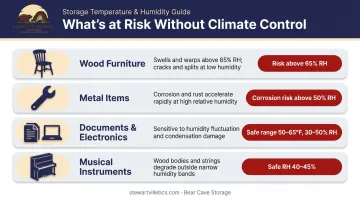
An enclosed building buffers these extremes by blocking direct wind, precipitation, and solar heat gain — a meaningful improvement over storing items in an open or drive-up space.
Enhanced Security
Indoor facilities typically stack multiple security layers: keypad or card access at the building entrance, individual unit locks, interior corridor cameras, and in some facilities, individual door alarms that log when specific units are opened or closed. Items inside are less visible from outside the property — a practical deterrent that outdoor units can't match by design.
What to Store in an Indoor Unit
- Furniture sets and upholstered items
- Electronics and appliances
- Documents, business records, and photos
- Artwork, collectibles, and antiques
- Musical instruments
- Seasonal clothing and textiles
If you wouldn't store it in an unheated garage from November through March, it belongs indoors.
What Is Outdoor Storage?
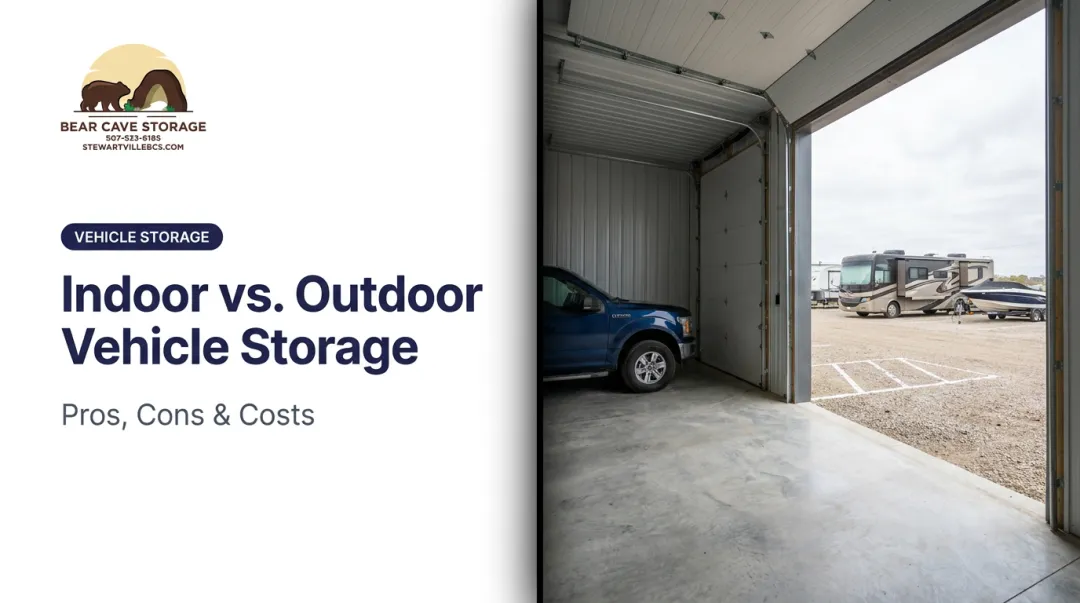
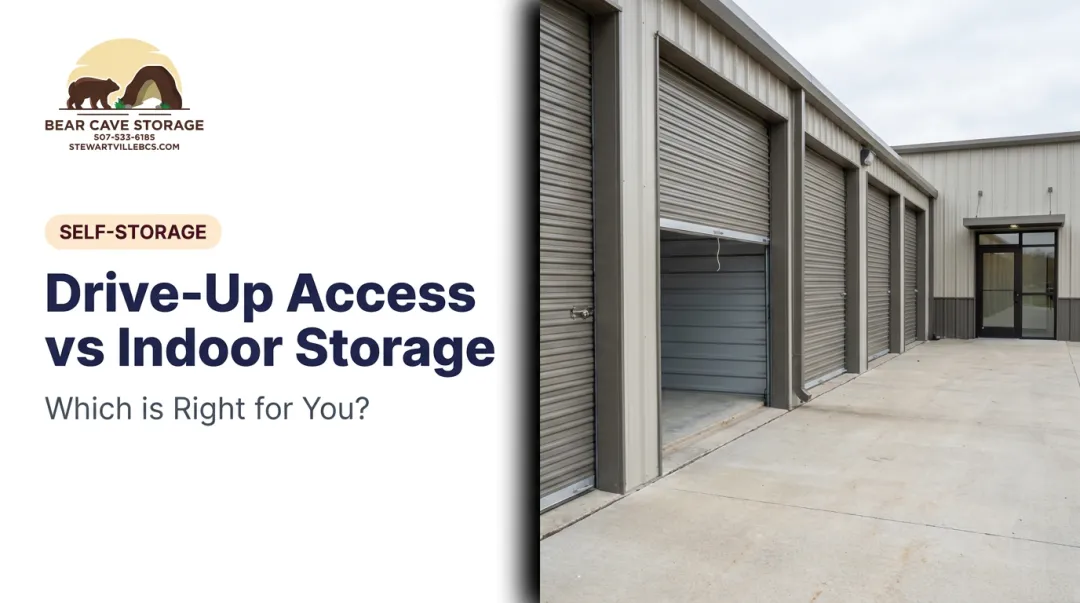
Outdoor storage — often called drive-up storage — consists of ground-level units with roll-up doors that open directly onto a paved or gravel lot inside a gated, fenced facility. No hallways, no elevators. Pull up, load or unload, and drive away — it's essentially extra garage space without the overhead.
Drive-Up Access and Convenience
The practical advantage is significant. You can back a truck or trailer directly to the unit door, load heavy items without navigating tight corridors, and spend five minutes instead of twenty-five. For anyone who visits their unit weekly — contractors pulling equipment, boat owners prepping for the season — outdoor access isn't just convenient, it's the difference between a storage unit you'll actually use and one you'll avoid.
Lower Cost and Larger Sizes
Outdoor units run noticeably cheaper than indoor equivalents. In the Minneapolis market, a 10x20 drive-up unit averages around $158/month, compared to roughly $193 for a comparable non-climate indoor unit.
Outdoor units also come in larger footprints. A 10x30 drive-up unit averages around $373/month in Minneapolis — still competitive for the square footage, and the size simply isn't feasible in most indoor corridor configurations.
Ideal for Vehicles and Oversized Equipment
Outdoor units handle what indoor facilities often can't accommodate:
- Cars, trucks, and classic vehicles
- Motorcycles, ATVs, and snowmobiles
- Boats, jet skis, and personal watercraft
- RVs, campers, and fifth-wheel trailers
- Lawn equipment, snowblowers, and trailers
- Contractor tools and construction materials
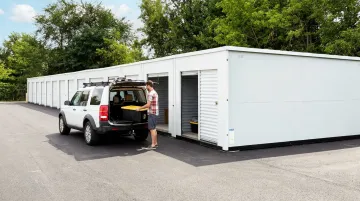
In Minnesota, keeping a snowmobile or boat in a secure fenced lot beats leaving it in the driveway all winter — both for theft prevention and neighbor relations.
Bear Cave Storage's outdoor fenced spaces in the Stewartville and Rochester area start at $65/month month-to-month, dropping to $58.50/month on a 12-month agreement — competitive even against the Minneapolis benchmarks above.
That said, outdoor units aren't the right fit for everything. Temperature swings and humidity make certain items risky to store outside.
What NOT to Store in an Outdoor Unit
- Documents, photos, and business records
- Electronics and computers
- Wooden furniture (susceptible to freeze-thaw humidity swings)
- Antiques and artwork
- Musical instruments
- Alkaline batteries (Battery University recommends against freezing)
- Rubber and plastic items (deteriorate under humidity above 65%)
Indoor vs. Outdoor Storage: Which Is Better for You?
There's no universal winner — only the right choice for your specific situation. Four factors drive the decision:
- What you're storing — sensitive vs. durable
- How often you need access — frequent loads vs. set-and-forget
- How long you're storing — short-term vs. multi-year
- Your local climate — moderate vs. extreme seasonal swings
Situational Recommendations
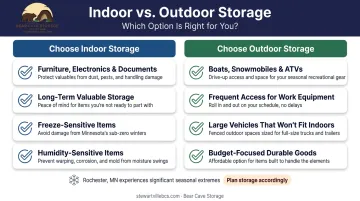
| Your situation | Better choice |
|---|---|
| Storing furniture, electronics, or documents | Indoor |
| Storing a boat, snowmobile, or ATV off-season | Outdoor |
| Long-term storage (1+ years) of valuables | Indoor |
| Frequent access for work equipment or inventory | Outdoor |
| Budget-focused short-term storage of durable goods | Outdoor |
| Items that would be damaged by freezing temps | Indoor |
| Large vehicle or trailer that won't fit inside | Outdoor |
The Minnesota Factor
Most storage guides treat climate as a footnote. In Minnesota, it's the deciding factor.
Rochester sees temperatures swing from below zero in January to 80°F+ in July, with morning humidity averaging 88% in summer and significant freeze-thaw cycling through spring and fall. Items stored in unheated outdoor units experience those full ambient swings — wood expands and contracts, metal corrodes, and condensation forms on cold surfaces when warmer air moves in.
Outdoor storage isn't the problem. Storing the wrong items outdoors is. A snowmobile, lawn tractor, or utility trailer handles Minnesota winters without issue. A box of client documents or a vintage guitar does not.
Bear Cave Storage offers both options at its facility serving Stewartville, Rochester, Byron, Racine, and Pine Island. Indoor units range from 10x10 to 10x30 (starting at $70/month), with enclosed indoor vehicle storage featuring a 14-foot overhead door for boats, cars, and RVs at $200/month. Outdoor fenced spaces start at $65/month.
Rentals are available online 24/7 — no office visit required.
If you're unsure which type fits your situation, call (507) 533-6185 or use the online reservation system to check availability by unit type and size.
Conclusion
The right choice comes down to what you're storing and how much protection it needs:
- Indoor storage provides consistent protection from humidity, freezing temperatures, and condensation — best for furniture, electronics, documents, and anything that would suffer in an unheated space
- Outdoor storage offers affordable, drive-up convenience for durable goods, vehicles, and items you need to access regularly
In Minnesota, the climate makes this decision more consequential than it might be in a milder region. Choosing the wrong unit type for a Rochester winter isn't just an inconvenience — a mismatch can mean damaged belongings and replacement costs that far exceed the monthly savings.
Bear Cave Storage serves the Rochester and Stewartville area with both options. Reach out at sales@bearcavestorage.com or (507) 533-6185 to find the right fit.
Frequently Asked Questions
Is it better to have a storage unit inside or outside?
It depends on what you're storing and how often you need access. Indoor units offer better protection for sensitive or high-value items, while outdoor drive-up units are more practical for vehicles, durable equipment, and frequent loading.
What's the average cost of a 10x20 storage unit in Minnesota?
Based on Rochester-area data from April 2026, a 10x20 outdoor drive-up unit averages around $158/month and a non-climate-controlled indoor unit averages around $193/month. Rates vary by facility and location.
Can outdoor storage units handle Minnesota winters?
Most outdoor units are built with sealed roll-up doors and durable construction, but they remain exposed to ambient temperatures. Items sensitive to freezing, condensation, or humidity swings — electronics, wood furniture, documents — should be kept in indoor storage during harsh winters.
What items should NOT be stored in an outdoor unit?
Avoid storing electronics, wooden furniture, documents and photos, antiques, artwork, musical instruments, and batteries in unheated outdoor units. Minnesota winters bring freezing temps and humidity swings that can damage all of these.
Do outdoor storage units come with climate control?
Climate control is rare in outdoor drive-up units. It's primarily a feature of enclosed indoor storage facilities. If you need regulated temperature or humidity, look specifically for climate-controlled indoor units and confirm the specs with the facility before renting.
How do I know what size storage unit I need?
Start by listing what you plan to store and whether you'll need room to access items easily. A 10x10 handles a room's worth of boxes or furniture; a 10x20 fits a full vehicle or two-bedroom home contents. Contact the facility — staff can match your list to the right dimensions.