The distinction matters because the two solutions serve completely different needs. A manufacturer managing a regional distribution network requires something fundamentally different from a homeowner between moves or a contractor keeping tools off-site. One needs an active logistics operation. The other needs a secure, accessible space.
This article breaks down exactly what separates warehousing from storage, who each option is built for, and how to figure out which one actually matches your situation.
Key Takeaways
- Warehousing is an active logistics operation — goods are received, tracked, picked, packed, and shipped as part of a supply chain
- Storage is passive, space-based rental: items are secured until the owner retrieves them, with no logistics services attached
- Warehouses serve B2B operations with high inventory turnover — self-storage fits individuals and small businesses with simpler, more flexible needs
- Self-storage is far more affordable when you don't need logistics services
- Small businesses often find a storage unit covers their needs without the cost or complexity of warehousing
Warehousing vs. Storage at a Glance
| Factor | Warehousing | Self-Storage |
|---|---|---|
| Primary Purpose | Active inventory management and distribution | Secure space for goods until retrieved |
| Typical Users | Manufacturers, e-commerce companies, distributors | Homeowners, small businesses, individuals in transition |
| Scale/Size | Large commercial facilities, often 50,000+ sq ft | Flexible units from 10×10 up to 20×40 |
| Services Included | Receiving, picking, packing, shipping, inventory tracking | Space rental only — no logistics services |
| Cost Structure | Storage + handling + labor + minimum charges | Flat monthly rate per unit size |
| Accessibility | Operator-controlled; access tied to service workflows | Self-managed, typically 24/7 |
| Best For | Businesses shipping orders regularly through a supply chain | Personal belongings, overflow inventory, seasonal items |
The right choice depends on how actively your goods need to move, what services you need, and your budget.
What Is Warehousing?
According to the Council of Supply Chain Management Professionals, warehousing is the part of a supply chain that stores raw materials, parts, work-in-process, and finished goods between their points of origin and consumption. That definition matters: warehousing is a coordinated logistics function, not simply a place to hold inventory.
Core Operational Functions
A warehouse runs as an active operation, not a passive holding area. The standard process steps, as documented by Inbound Logistics, include:
- Receiving — unloading inbound shipments and verifying contents against purchase orders
- Putaway — moving goods to designated storage locations in the facility
- Storage — holding inventory in an organized, trackable system
- Picking — selecting specific items to fulfill outbound orders
- Packing — preparing orders for shipment with appropriate materials
- Shipping — dispatching outbound orders to customers or distribution points
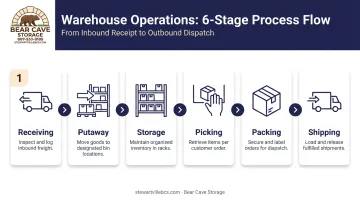
Commercial warehouse contracts typically extend beyond those six steps to include inventory checks, special stock statements, labeling, marking, and packaging services. That operational scope is what separates warehousing from simpler storage arrangements.
Types of Warehousing Facilities
- Private warehouses — owned and operated by a single company for its own inventory
- Public/third-party warehouses — shared facilities offering storage and services to multiple clients
- Contract warehouses — third-party facilities operating under a long-term agreement for a specific client
- Distribution centers (DCs) — hold inventory from manufacturing and distribute to stores or regional hubs
- Fulfillment centers (FCs) — a specialized DC type that processes and ships individual e-commerce orders directly to consumers
- Cold/refrigerated storage — temperature-controlled facilities for perishable goods (classified separately under NAICS 493120)
Who Uses Warehousing?
Warehousing is primarily a B2B solution designed for businesses whose goods move constantly:
- Manufacturers storing raw materials and finished goods before distribution
- E-commerce companies needing daily order fulfillment at scale
- Retail and wholesale distributors managing high-volume inventory flows
If your business ships hundreds or thousands of orders per week and needs a third party to handle receiving, picking, and outbound shipping, warehousing is the right fit. If you're holding a set of pallets for a season and retrieving them yourself, that use case falls closer to self-storage — a separate category covered below.
What Is Self-Storage?
Self-storage is classified under NAICS 531130 as establishments engaged in renting or leasing secure space — rooms, compartments, lockers, or outdoor areas — where clients store and retrieve their own goods. The core distinction from warehousing is embedded in that definition: clients store and retrieve their own goods. No third party handles, tracks, or ships anything.
Key Characteristics
- Tenant-controlled access — you manage your unit on your own schedule
- Simple monthly rental — flat rate based on unit size, no labor or service charges layered on top
- Flexible sizing — units typically range from 5×5 (25 sq ft) up to 10×30 (300 sq ft) or larger
- No minimum volume — rent what you need, from a single unit to several, with no throughput requirements
- Minimal operational complexity — no warehouse management systems, no staffing overhead, no logistics contracts
Types of Storage Facilities
- Indoor self-storage units — enclosed units in a building, protected from weather
- Outdoor fenced storage — open or semi-covered spaces for vehicles, RVs, boats, and trailers
- Vehicle/enclosed indoor storage — garage-style spaces for cars, boats, or motorcycles needing full protection
- Climate-controlled storage — available at some facilities; regulates temperature or humidity for sensitive items (not offered at all locations)
- Portable/mobile storage — containers delivered to your location, then transported to a facility
The U.S. self-storage industry encompasses more than 50,000 facilities and over 2.1 billion square feet of space nationally, with 12.6% of U.S. households actively renting a unit according to the SSA's 2025 Demand Study. Both residential and business renters are well-documented user groups.
Who Uses Self-Storage?
- Homeowners decluttering, downsizing, or between moves
- Individuals navigating life transitions — renovations, divorce, temporary relocations
- Small businesses managing overflow inventory, seasonal equipment, or off-site supplies
- Contractors storing tools and materials near job sites
For most of these users, the appeal is straightforward: show up, load your unit, and pay a flat monthly rate. No contracts to negotiate, no logistics vendors to manage.
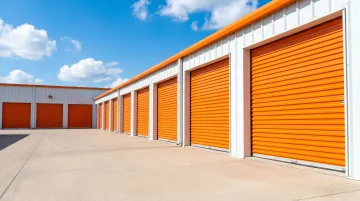
Bear Cave Storage, based in Stewartville, MN, serves residential and business customers across the Rochester area — with indoor units ranging from 10×10 up to 10×30 (plus a single 20×40 space), outdoor fenced storage for vehicles, RVs, boats, and trailers, and enclosed indoor vehicle storage with drive-up access. All rentals are month-to-month with no long-term commitment required.
Which One Do You Actually Need?
This is where most confusion lives. Here are the decision factors worth evaluating honestly:
Ask Yourself These Questions
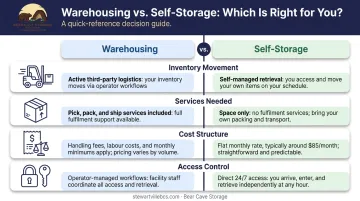
- Does inventory need to move actively? If goods are being received, picked, packed, and shipped regularly by a third party, you need warehousing. If you're moving items in and out yourself, self-storage works.
- Do you need value-added services? Fulfillment, inventory management systems, and outbound shipping are warehousing functions — none of them come with a storage unit rental.
- What's your budget tolerance? Self-storage monthly rates average $85.30 nationally (as of July 2025, per SpareFoot). Warehousing costs layer in handling charges, minimum commitments, and labor — significantly higher for most small operations.
- How important is direct access? Self-storage gives you the keys. Warehousing means working within the facility's operating workflows.
Clear Situational Guidance
Choose warehousing if:
- Your business ships orders regularly and needs integrated pick/pack/ship services
- You need third-party inventory management and reporting
- You're operating at scale where per-unit handling costs make sense
Choose self-storage if:
- You need a safe, accessible place to keep items until you retrieve them yourself
- You're storing personal belongings, seasonal items, or business overflow
- You want flexible month-to-month terms without logistics commitments
The Small Business Gray Area
Many small businesses instinctively reach for "warehousing" because it sounds more professional. But if your order volume is low, if you're picking up inventory yourself, or if you just need a secure place to stage supplies between jobs, a storage unit is a better fit across the board.
You get direct access on your own schedule, straightforward pricing, and no minimum commitment that assumes volume you may not have.
If you're in the Rochester or Stewartville area and self-storage fits your situation, Bear Cave Storage's range of unit sizes — from compact 10×10 spaces to larger 10×30 and 20×40 units — covers personal and small business needs alike. Outdoor fenced spaces accommodate commercial vehicles and equipment, and the rental process is available online, 24/7.
Conclusion
Warehousing and storage both serve real purposes. The difference is who they're built for and what problem they actually solve. Warehousing is logistics infrastructure for businesses running active supply chains. Self-storage is flexible, accessible space for anyone who needs to hold items securely until they're ready to use or move them.
For most individuals and small businesses, the simplicity and affordability of a quality self-storage facility covers everything they need. There's no need to take on the overhead of a warehousing contract built for a completely different scale of operation. If you're in the Rochester or Stewartville area and just need secure, accessible space without the complexity, Bear Cave Storage offers flexible month-to-month rentals for exactly that.
Frequently Asked Questions
What's the difference between storage and warehousing?
Warehousing is an active logistics operation where a third party receives, manages, and ships your inventory as part of a supply chain. Storage is passive space rental — you place items securely and retrieve them yourself when needed.
What are the four types of warehousing?
The four common types are:
- Private warehouses — company-owned facilities used for a business's own goods
- Public warehouses — shared facilities serving multiple clients on flexible terms
- Distribution centers — inventory held for redistribution to stores or regional hubs
- Fulfillment centers — specialized facilities processing individual consumer orders directly
What is the difference between an FC and a DC?
Per the IWLA glossary, a fulfillment center processes and ships individual e-commerce orders directly to consumers, while a distribution center holds inventory from manufacturing and moves it to stores or other distribution points. Both are warehouse types, but they serve different stages of the supply chain.
What is the 5S rule in warehousing?
5S stands for Sort, Set in Order, Shine, Standardize, and Sustain — a warehouse organization methodology used to improve efficiency, reduce errors, and maintain safe working conditions. It originated in lean manufacturing and is a standard practice in large-scale warehouse operations.
Can a small business use self-storage instead of a warehouse?
Yes — and many small businesses are better served by it. If order volumes are low and you're handling inventory yourself, a self-storage unit offers flexible sizing, affordable monthly rates, and direct access without any logistics contract or minimum commitment.
Is self-storage cheaper than warehousing?
Self-storage charges for space only — no staffing, inventory systems, or fulfillment services built in. The national average runs around $85/month for a standard unit. Warehousing costs include handling charges, labor, and minimum fees that make it significantly more expensive when those services aren't needed.