Introduction
Inventory stacked in hallways. Tools taking over the back of a van. Documents piled on desks that were never meant to hold them. When a business outgrows its space, the friction shows up everywhere — in wasted time, damaged goods, and operations that never quite catch up.
Renting a storage unit solves the space problem, but only if you pick the right one. A unit that works fine for storing seasonal decorations won't hold up when you're protecting $20,000 worth of contractor equipment or product inventory that needs to ship on time.
According to SBDCNet's self-storage business snapshot, businesses — including retailers, wholesalers, and small companies — make up 18.4% of self-storage customers. That's a significant slice of tenants with operational needs that go well beyond "a dry place to put stuff."
This guide walks through the specific features that make a storage unit genuinely useful for a business: security, weather protection, accessibility, and flexible terms. The right combination can mean the difference between a unit that supports your operations and one that creates new headaches.
Key Takeaways
- Security is non-negotiable — look for gated access, individual unit locks, surveillance cameras, and on-site lighting
- Weather protection is critical for inventory and equipment, particularly through Minnesota's harsh winters
- Drive-up access and 24/7 hours directly affect how efficiently your business operates
- Month-to-month agreements give you the flexibility to scale up or down without financial penalties
- Match features to your business type — what works for a contractor differs significantly from what a retailer or service provider needs
Why the Right Storage Features Matter for Your Business
Choosing the wrong storage unit doesn't just cost money — it can disrupt operations, delay jobs, and leave valuable inventory or equipment exposed.
The Self Storage Association is clear on one thing: a self-storage operator rents you space, but the care, custody, and control of what's inside belongs entirely to the tenant. That means the burden of choosing the right features falls on you, not the facility.
For personal storage, a lapse in judgment might mean a damaged lamp. For a business, the stakes are different:
- Inventory that gets damaged and can't be sold or returned
- Equipment stolen, delaying jobs and triggering insurance claims
- Units inaccessible during critical delivery or fulfillment windows
- Money spent on space that doesn't match how you actually work
Those risks aren't universal, though — they depend on how your business uses storage. A contractor pulling tools at 6 a.m. has different requirements than a retailer storing seasonal stock or a law firm archiving documents. The right features for your situation depend on your industry, your hours, and what you're protecting.
Security Features Every Business Storage Unit Should Have
Commercial assets have real financial value, and Inside Self-Storage identifies burglary as the most common crime in the self-storage industry. That makes security your first filter when evaluating any facility — not an optional upgrade.
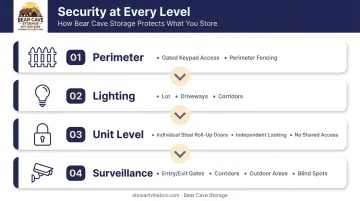
What to Verify at the Perimeter Level
Before you even look at a unit, check what's protecting the property itself:
- Gated access with keypad or PIN entry, so only authorized tenants can enter the grounds
- Perimeter fencing that creates a clear boundary and deters casual access
- On-site lighting across the lot, driveways, and access corridors — well-lit facilities deter unauthorized activity and make after-hours access safer for legitimate tenants
What to Check at the Unit Level
The perimeter keeps out strangers. The unit-level security protects your specific assets:
- Confirm roll-up steel doors with individual locking mechanisms — each unit should lock independently, not through shared access points
- Find out whether the facility provides locks or whether you supply your own
- Verify there are no shared access points between adjacent units or corridors
Surveillance: What Good Coverage Looks Like
Camera placement matters as much as whether cameras exist. Look for coverage at:
- Entry and exit gates
- Corridors and hallways between units
- Outdoor storage areas and parking lots
- Any blind spots or low-traffic corners where activity is harder to detect
Facilities that take surveillance seriously cover all of these areas — not just the front gate. Bear Cave Storage includes digital video surveillance as part of their 24/7 security setup, with gated access across both indoor and outdoor storage areas. When evaluating any facility, ask directly whether cameras are actively monitored or recorded only: active monitoring means someone can respond in real time, while recorded-only means footage is reviewed after an incident.
Climate and Weather Protection: Safeguarding Business Assets
Rochester's average monthly temperatures run from 14.7°F in January to 70.5°F in July, according to NOAA's 1991–2020 climate normals. Minnesota DNR data puts southern Minnesota's winter averages around 18°F. That swing is wide enough to damage inventory that most business owners assume is durable — and few account for it when choosing storage.
What's Actually at Risk
Many business owners don't realize how many common inventory categories are sensitive to temperature and humidity swings:
- Electronics: Circuit boards and components degrade with moisture exposure
- Paper documents and records: The Smithsonian recommends paper-based collections be stored at 30–50% relative humidity; outside that range, warping, mold, and brittleness accelerate
- Products with adhesive labels: Avery Dennison's technical guidance recommends storage at approximately 72°F and 50% RH for pressure-sensitive labels — heat and humidity cause labels to peel, bubble, or fail
- Wooden furniture and wood-based materials: Humidity fluctuations cause swelling, splitting, and warping
- Metal equipment: The Self Storage Association notes that corrosion and mold growth increase sharply when relative humidity rises above 50–55%
Temperature Control vs. True Climate Control
These aren't the same thing, and the distinction matters:
| Feature | What It Does | Best For |
|---|---|---|
| Heated storage | Prevents freezing in winter only | Basic protection from extreme cold |
| Climate control | Regulates both temperature and humidity year-round | Sensitive inventory, documents, electronics |
If you're storing anything from the list above, ask specifically whether the unit controls humidity — not just temperature.
Bear Cave Storage's indoor units keep your inventory out of direct weather exposure — shielded from Minnesota's freeze-thaw cycles, precipitation, and temperature extremes. For businesses with inventory that needs humidity regulation specifically, contact them directly at (507) 533-6185 to confirm what conditions their indoor units provide before committing.
Accessibility and Convenience Features That Keep Operations Running
For business tenants, accessibility isn't a bonus feature — it's the baseline requirement. How and when you can reach your unit directly affects whether a facility actually fits into your workflow.
24/7 Access: More Than a Convenience
Business schedules don't conform to 9-to-5. Contractors start early, retailers receive shipments on tight timelines, and e-commerce operators fulfill orders on weekends.
Bear Cave Storage offers 24/7 gated access across both indoor units and outdoor storage spaces, so tenants can retrieve equipment or inventory at any hour. Access restrictions vary widely across providers, so confirm the hours policy before committing to any facility.
Drive-Up Access: Essential for Heavy or Bulk Items
Drive-up access — where you pull a vehicle directly to the unit door — is one of the most practically useful features for business tenants. It matters if you:
- Regularly move tools, equipment, or bulk inventory
- Use a dolly, hand truck, or pallet jack
- Arrive with a loaded van or truck
Bear Cave Storage offers drive-up access across their indoor unit range, from 10x10 units up to their 20x40 unit. For businesses storing larger items or arriving with commercial vehicles, the facility also provides large overhead door access — including a 14-foot overhead door on shared indoor spaces — which accommodates tall vehicles and oversized equipment.
Delivery Acceptance
Drive-up convenience only helps when you're on-site. If your business receives shipments while you're away, you'll also want to know whether the facility accepts deliveries on your behalf. This policy varies widely — some facilities handle it routinely, others don't offer it at all. Bear Cave Storage's delivery acceptance policy isn't documented publicly, so it's worth a direct conversation before you rely on it.
Flexibility and Scalability: Storage That Grows With Your Business
Business storage needs change. A seasonal retailer might need twice the space in Q4 that they use in February. A growing contractor acquires tools faster than they can allocate permanent space. A startup e-commerce operation outgrows a 10x10 within a year.
The storage industry is built around this reality. The Self Storage Association states that virtually all self-storage rentals operate on a month-to-month basis — which is structurally different from commercial leases that lock you in for years.
Why Month-to-Month Terms Work for Businesses
- Upsize without penalties when inventory or equipment grows
- Downsize after peak seasons rather than paying for empty space
- Exit cleanly if your business relocates or storage needs disappear
Bear Cave Storage offers month-to-month rentals as standard. Longer commitments are also available for businesses whose needs have stabilized — giving you the option to start flexible and adjust as your operation grows.
Multiple Sizes at the Same Facility
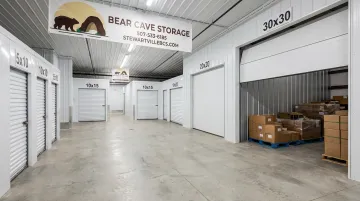
Scalability also means being able to move up or down within a facility you already know. Bear Cave Storage's indoor units range from 10x10 up to 10x30, with a 20x40 unit available for larger storage needs — enough range that most businesses can scale up without switching facilities.
Available indoor unit sizes include:
- 10x10 — tools, small inventory, filing and equipment
- 10x20 — larger equipment, stock, or mixed business use
- 10x30 — suitable for contractors or higher-volume storage
- 20x40 — for businesses needing maximum indoor space
Locations across the Rochester and Stewartville area mean businesses can find a unit close to where they actually operate — whether that's a job site in Byron, a retail location in Rochester, or a home office nearby.
Matching Storage Features to Your Business Type
Different businesses have different priorities. Here's a quick framework:
| Business Type | Top Features to Prioritize |
|---|---|
| E-commerce / Retail | Drive-up access, unit size range, weather-protected indoor storage |
| Contractors / Trades | Drive-up access, 24/7 hours, large unit availability, outdoor space for equipment |
| Professional services (legal, medical, financial) | Secure indoor units, gated access, flexible monthly terms |
| Seasonal businesses | Month-to-month terms, ability to upsize/downsize between seasons |
The Storage Audit: Do This Before You Sign
Before committing to any unit, answer these questions:
- What are you storing? List specific items — tools, inventory, documents, equipment
- How often will you access it? Daily, weekly, or occasional retrieval
- Are any items sensitive to weather or moisture? Electronics, paper, wood, labels
- What vehicle will you arrive in? Standard car, van, box truck, trailer
- When do you need access? Early morning, evenings, weekends
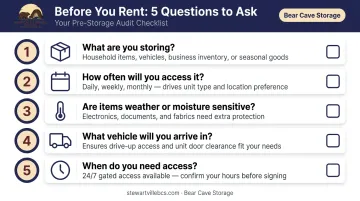
That list tells you exactly which features are required versus optional. Businesses near Rochester and Stewartville can contact Bear Cave Storage to walk through unit options against that checklist — they offer a range of unit sizes, drive-up access, and 24/7 availability suited to most contractor and small business needs.
Frequently Asked Questions
What size storage unit does a small business typically need?
Most small businesses start with a 10x10 or 10x15 unit for inventory and equipment. The right size depends on volume, access frequency, and whether you use shelving to maximize vertical space. A well-organized 10x10 can hold more than it looks.
Is climate-controlled storage worth it for business inventory?
For businesses storing electronics, documents, or moisture-sensitive goods, temperature and humidity control can prevent costly damage. Not all facilities offer true climate control, so confirm exactly what conditions a unit maintains before assuming any indoor space qualifies.
What security features should I look for in a business storage unit?
The core checklist: gated keypad access, individual unit locks with no shared access points, perimeter surveillance cameras covering entry/exit and corridors, and adequate lighting for after-hours access. Verify all four before signing.
Can I receive business deliveries at a self-storage facility?
Some facilities accept deliveries on behalf of tenants; many don't. If regular shipments are part of your operation, confirm this policy upfront before signing. It varies by location and isn't something to assume.
How do I know if I need drive-up access for my business storage unit?
If you regularly move heavy items or arrive with a loaded truck or van, drive-up access saves significant time on every visit. Interior units accessed via hallway or elevator become impractical quickly for frequent commercial use.
Is month-to-month storage rental better than a long-term lease for businesses?
For most businesses, yes, especially if storage needs are seasonal or tied to growth phases. Month-to-month terms let you adjust space up or down without financial penalties. Long-term discounts (like Bear Cave Storage's 10% discount for 12-month commitments) can make sense once your needs stabilize.