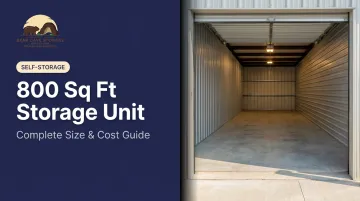
Units at this scale sit at the far end of the self-storage spectrum. They're not standard inventory at most facilities, they don't price like residential units, and the terminology alone trips people up. This guide covers what an 800 sq ft unit actually is, what it realistically costs, what drives the price, and how to decide whether it's the right fit — or whether a smaller option would serve you just as well.
Key Takeaways
- An 800 sq ft storage unit (typically a 20x40) provides warehouse-scale floor space; note that 800 cubic feet is a very different, much smaller size (closer to a 10x10)
- Bear Cave Storage offers a 20x40x10 unit with drive-up access starting at $108/month (month-to-month) or as low as $97.20/month on a 12-month lease
- Climate control, lease length, unit type, and location are the four biggest cost drivers nationally
- This size suits large home relocations, vehicle storage, contractor equipment, and commercial inventory — not everyday decluttering
- For needs closer to 300–400 sq ft, two medium units typically offer better availability and more flexibility than one large unit
What Is an 800 Sq Ft Storage Unit?
Here's where most people get tripped up before they even call a facility: 800 sq ft and 800 cubic feet are completely different measurements.
According to Public Storage's size guide, a standard 10x10 unit is 100 sq ft of floor space with approximately 800 cubic feet of volume (at an 8-foot ceiling). So when someone says "I need 800 cubic feet of storage," they're describing a 10x10 — a unit that fits a small apartment. An 800 square foot unit is eight times larger.
Common Dimensions and Configurations
An 800 sq ft unit means 800 sq ft of floor area. The most common configuration is a 20x40 footprint: 20 feet wide, 40 feet deep. Ceiling height varies by facility, but Extra Space Storage confirms that most units run around 8 feet, with select locations reaching 10 feet. Bear Cave Storage's 20x40 unit has a 10-foot ceiling, giving it roughly 8,000 cubic feet of usable volume — plenty of headroom for stacked furniture, tall equipment, or vehicles.
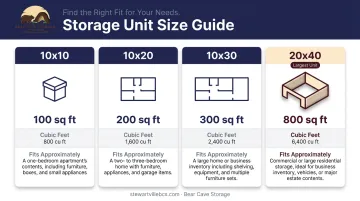
Here's how 800 sq ft stacks up against standard sizes:
| Unit Size | Floor Area | Approx. Cubic Feet (8 ft ceiling) | Fits Approximately |
|---|---|---|---|
| 10x10 | 100 sq ft | 800 cu ft | Small apartment |
| 10x20 | 200 sq ft | 1,600 cu ft | 3-bedroom home |
| 10x30 | 300 sq ft | 2,400 cu ft | 5-bedroom home |
| 20x40 | 800 sq ft | 6,400–8,000 cu ft | Full home + vehicles + inventory |
What Fits in an 800 Sq Ft Storage Unit
A 20x40 can hold significantly more than any standard residential unit. Realistic contents include:
- Full furniture from a 5–6 bedroom home (multiple bedroom sets, sectionals, dining sets, appliances)
- 2–3 vehicles, or a car plus a boat on trailer or a motorcycle
- Large commercial inventory or contractor tools and materials
- 100–200+ moving boxes alongside major appliances like washers, dryers, and refrigerators
This size is purpose-built for full home relocations, estate cleanouts, business overflow, or combining vehicle storage with large household goods — not for clearing out a spare room.
How Much Does an 800 Sq Ft Storage Unit Cost?
Pricing for 800 sq ft storage units varies more than at standard residential sizes. Availability is limited, and facilities that offer this footprint price it based on local demand, unit type, and included features — so the range is wide.
Typical Monthly Cost Ranges
National pricing data for 20x40 units specifically isn't well-documented. For context, SpareFoot's 2026 cost data shows the national average across all sizes sits around $85/month, with large units averaging $169/month and extra-large units averaging $265/month. An 800 sq ft unit sits well above these benchmarks.
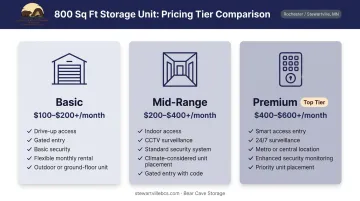
Here's a realistic directional breakdown by tier:
| Tier | Monthly Estimate | What's Typically Included |
|---|---|---|
| Basic (non-climate, drive-up) | $100–$200+ | Drive-up access, basic security, gated entry |
| Mid-Range (standard security, indoor) | $200–$400+ | Indoor access, CCTV, standard security features |
| Premium (urban/high-demand market) | $400–$600+ | Smart access, 24/7 surveillance, flexible lease, metro location |
At Bear Cave Storage, the 20x40x10 unit — a drive-up, protected indoor unit — falls in the Basic tier and is priced as follows:
- Month-to-month: $108/month
- 6-month lease: $102.60/month (5% discount)
- 12-month lease: $97.20/month (10% discount)
That's a competitive rate for the Rochester/Stewartville, MN area. For comparison, St. Paul benchmarks put 10x30 units at around $282/month — a smaller footprint at a higher price.
Annual Cost Perspective
The annual commitment matters more at this size than at smaller units:
- Month-to-month at Bear Cave Storage: ~$1,296/year
- 12-month lease at Bear Cave Storage: ~$1,166/year (saving ~$130 annually)
- Premium urban market estimate: $4,800–$7,200/year
Those numbers are a useful baseline, but advertised rates don't always tell the full story. Before committing, ask each facility for three figures: base monthly rent, total move-in cost, and all-in recurring monthly cost. Insurance requirements, administrative fees, and lock purchases are often extra.
Key Factors That Affect the Cost of an 800 Sq Ft Storage Unit
Four main variables drive pricing at this scale: location, climate control, unit type, and lease structure. Knowing how each one works makes it easier to compare quotes side by side.
Location and Local Market Demand
Urban and coastal markets consistently charge more than suburban or rural facilities. StorageCafe notes that pricing for identical unit sizes can vary by thousands of dollars annually depending on location and demand. A 20x40 in Manhattan or San Francisco will cost multiples of what the same footprint runs in Stewartville, Minnesota.
For renters in the Rochester/Stewartville area, Bear Cave Storage's pricing reflects a moderate suburban Minnesota market — well below what major metro facilities charge for comparable space.
Climate Control
StorageCafe reported in January 2026 that climate-controlled units run approximately 12.5% more than non-climate-controlled units nationally. At 800 sq ft, that premium is applied to a large footprint — so it adds up fast.
Climate control matters most for:
- Wood furniture stored long-term
- Electronics and documents
- Leather goods and textiles
- Vehicles stored through harsh winters
Bear Cave Storage does not offer climate-controlled storage, so if your items require temperature and humidity regulation, factor that into your facility comparison.
Unit Type: Drive-Up vs. Indoor Corridor
Drive-up units — where you pull directly to a ground-level door — typically cost less than interior corridor-access units. At 800 sq ft, that cost difference is meaningful — and drive-up access becomes practically necessary for loading large furniture, vehicles, and equipment efficiently. Bear Cave Storage's 20x40 unit offers drive-up access with overhead protection for high-volume loads.
Lease Length and Security Features
- Month-to-month leases offer flexibility but carry a higher monthly rate
- Committing to 6 or 12 months reduces costs — at Bear Cave Storage, a 12-month lease saves roughly $130 over the year versus month-to-month
- Security features (24/7 CCTV, gated access, on-site management) add to operating costs and are reflected in rent
Bear Cave Storage includes 24/7 gated security across all units.
What Most People Get Wrong About Large Storage Units
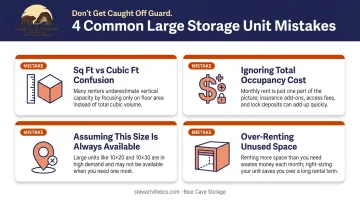
Four mistakes come up repeatedly when renters shop at this size — and each one either costs money or derails a move-in plan entirely.
- Square feet vs. cubic feet confusion. A 10x10 is 100 sq ft but roughly 800 cubic feet. An 800 sq ft unit is a 20x40 — closer to a large garage or small apartment. Conflating the two leads to severe overestimation or real sticker shock.
- Ignoring total cost of occupancy. The advertised monthly rate rarely includes insurance, administrative fees, or a required lock. At a $108/month base rate, even modest add-ons are a meaningful percentage increase. Always ask for the all-in monthly figure before comparing facilities.
- Assuming every facility offers this size. Most self-storage operators top out around 10x30 (300 sq ft). Extra Space Storage's general size guide calls the 10x30 one of its largest common units. A 20x40 exists at select facilities — but confirm availability before building plans around it.
- Over-renting because it's the largest option. A 20% buffer on your storage estimate is reasonable. Jumping from a 400 sq ft need to 800 sq ft because it's the only large unit available means paying for 400 sq ft of empty floor space every month.
Is an 800 Sq Ft Storage Unit Right for You?
This size genuinely fits a narrow set of use cases:
- Families relocating from a large home and needing temporary full-contents storage
- Business owners storing commercial inventory or equipment
- Contractors who need secure, accessible space for tools and materials
- Anyone storing multiple vehicles alongside full household goods
If none of those describe your situation, a smaller unit almost certainly covers your needs at lower cost.
When to Consider Alternatives
Two 10x20 units provide 400 sq ft total — half the floor space of a 20x40, but sometimes enough if your actual need is closer to 400 sq ft. The tradeoff: two leases to manage and no contiguous floor space for large items like vehicles or long furniture pieces.
For true commercial-scale storage needs — where you need power outlets, loading docks, or zoning flexibility — warehouse or commercial flex space may be a better fit than a self-storage unit at any size.
If you're in the Rochester or Stewartville, MN area, Bear Cave Storage offers the full unit range from 10x10 up through 20x40, plus outdoor fenced vehicle storage as an alternative for those who need vehicle space without the cost of a full indoor unit. Call (507) 533-6185 or email sales@bearcavestorage.com to confirm availability and find the right fit for your situation.
Frequently Asked Questions
What size storage unit do I need for a 3-bedroom house?
A 3-bedroom home typically fits in a 10x20 (200 sq ft) to 10x25 unit, depending on how densely furnished it is and whether appliances are included. An 800 sq ft unit would be substantially more space than needed for a standard 3-bedroom home.
How many square feet is a 10x20 storage unit?
A 10x20 unit is 200 sq ft of floor space, with approximately 1,600 cubic feet of volume at a standard 8-foot ceiling height. That's large enough for a 3-bedroom home's contents, but only a quarter the size of an 800 sq ft unit.
How much does an 800 sq ft storage unit cost per month?
Costs vary widely by location, climate control, and lease type. At Bear Cave Storage in Rochester/Stewartville, MN, the 20x40x10 unit starts at $108/month (month-to-month) or $97.20/month on a 12-month lease. Urban or premium markets often run $200–$400/month or more. Contact local facilities directly for current quotes.
What is the difference between 800 square feet and 800 cubic feet in storage?
800 cubic feet is the volume of a 10x10 unit (100 sq ft floor, 8-foot ceiling), suitable for a small apartment's worth of belongings. 800 square feet describes the floor area of a 20x40 unit — roughly the size of a large two-car garage.
What are common dimensions for an 800 sq ft storage unit?
The most common configuration is 20x40 feet. Other combinations that reach 800 sq ft exist but are less standardized across facilities. Not all facilities offer this size — availability varies significantly by location.
Is an 800 sq ft storage unit the same as a warehouse?
Not quite. While the footprint approaches warehouse scale, a self-storage unit typically lacks loading docks, electrical outlets, and flexible commercial zoning. Use it for high-volume storage — not as a substitute for a commercial workspace.