
Many storage unit renters wonder whether their monthly rental cost is tax-deductible. The short answer: it depends on how you use the unit, not the unit itself.
The IRS allows storage deductions in specific qualifying situations. Three main categories apply: business or self-employment use, rental property management, and active-duty military relocation. Pure personal storage — holiday decorations, spare furniture, childhood memorabilia — doesn't qualify under current rules.
This guide covers who qualifies, which tax forms to use, how to handle mixed personal and business storage, and what records to keep.
TL;DR: Storage Unit Tax Deductions at a Glance
- Business owners and self-employed individuals can deduct storage costs when the unit is used exclusively for business purposes
- Rental property owners can deduct storage tied to managing their properties — claimed on Schedule E
- Active-duty military members may deduct storage costs connected to a permanent change of station (PCS) move
- Personal storage is not deductible under current IRS rules
- The Tax Cuts and Jobs Act (2018) removed moving expense deductions for most civilians; active-duty military remain the only exception
When Is a Storage Unit Tax Deductible?
The IRS "Ordinary and Necessary" Standard
IRS Publication 535 establishes the core test for business expense deductions: expenses must be both ordinary (common and accepted in your industry) and necessary (helpful and appropriate for your business). A storage unit used to house business inventory, tools, or equipment meets both criteria. The cost is common across many industries and directly supports business operations.
This standard comes from 26 U.S. Code § 162, which governs trade and business expense deductions broadly.
Qualifying Deduction Categories
| Category | Deduction Pathway | Current Status |
|---|---|---|
| Business/self-employment use | Schedule C (Form 1040) | Fully available |
| Rental property use | Schedule E (Form 1040) | Fully available |
| Active-duty military PCS move | Form 3903 | Available (TCJA exemption) |
| Civilian moving expenses | N/A | Suspended 2018–2025 via TCJA |
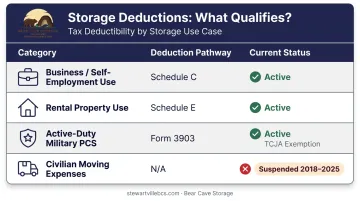
The Tax Cuts and Jobs Act suspended the civilian moving expense deduction starting in 2018. As of publication, that suspension runs through 2025 — verify current law with your tax professional, as Congress may extend or modify this provision.
The Exclusive Use Rule
For a storage unit to be fully deductible as a business expense, it should be used only for business purposes. Storing a mix of personal and business items in the same unit creates a compliance problem — you can only deduct the business-use percentage, and documenting that split requires extra record-keeping.
The simplest approach: rent a dedicated unit exclusively for business use.
The Rental Property Exception
Rental property storage follows different rules than home-based business storage. Those costs are deductible under Schedule E and operate on their own pathway entirely. Landlords who store appliances, repair supplies, paint, and maintenance tools have a clear, well-established pathway to this deduction.
Minnesota State Tax Note
Federal deduction rules are only part of the picture. State rules don't always mirror them — Minnesota residents should verify whether the state follows the same deduction standards as the IRS, and the Minnesota Department of Revenue publishes annual federal conformity updates that are worth reviewing.
Who Qualifies for a Storage Unit Tax Deduction?
Business Owners and Self-Employed Individuals
Any self-employed person or business owner can deduct storage unit rent when the unit is used solely to support business operations. The expense is reported as "Other Expenses" on Schedule C (Form 1040).
Common business types that regularly qualify:
- E-commerce sellers (Amazon, Etsy, eBay) storing product inventory
- Contractors and landscapers storing tools, equipment, and materials
- Photographers and event planners storing props, backdrops, and gear
- Real estate agents storing staging furniture between listings
- Small retailers with seasonal overflow or excess stock
Renting a dedicated unit solely for business use — rather than mixing personal items in — is the cleanest way to claim the full deduction. Bear Cave Storage, for example, offers commercial units in Rochester and Stewartville, MN with drive-up access and flexible month-to-month terms that suit seasonal business needs.
Rental Property Owners
Landlords can deduct storage costs when the unit holds items directly tied to their rental property — appliances waiting to be installed, repair materials, paint, seasonal maintenance supplies, and similar items.
These expenses go on Schedule E (Supplemental Income and Loss), reported as a rental property operating expense. The key is linking the expense specifically to the rental property it supports in your documentation.
Active-Duty Military Members
Active-duty military personnel who move under a permanent change of station (PCS) order can still deduct storage costs — this exemption survived the TCJA when the civilian moving deduction was suspended. Eligible costs include storage-in-transit fees and temporary storage for up to 30 days.
According to IRS Topic 455, this deduction is claimed on Form 3903 (Moving Expenses) and requires official military orders plus receipts for all storage costs.
Who Does NOT Qualify
Personal storage is not tax-deductible, period. This includes:
- Furniture stored between moves
- Holiday decorations and seasonal items
- Collectibles, hobby equipment, or memorabilia
- General home overflow
Civilians relocating for a new job also cannot deduct storage costs under current law. The TCJA suspension covers most non-military filers — verify with a tax professional whether this has changed.
What If You Store Both Personal and Business Items?
The Proration Method
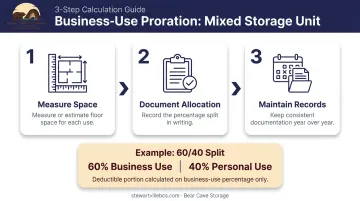
When a unit holds both personal and business items, only the business-use percentage is deductible.
Example: If 60% of your unit's space holds business inventory and 40% holds personal items, you can deduct 60% of the monthly rent as a business expense. If rent is $100/month, your deductible amount is $60/month — $720/year.
Applying this in practice requires:
- Measuring or estimating the floor space dedicated to each use
- Documenting that allocation in writing
- Maintaining consistent records year over year
Why Separate Units Are Safer
That said, proration only works if you can defend the numbers under scrutiny. Mixing personal and business items introduces ambiguity and increases audit risk. A dedicated business unit eliminates the need to calculate and defend a percentage split.
If you're already renting a unit for personal use, adding a separate small unit for business — even a 10×10 — makes the deduction straightforward to document and defend.
What to Avoid
Don't classify a storage unit as a "second office" or "home office equivalent" on your return. The IRS treats storage rental costs as an addition to existing business rent expenses on Schedule C — not as a separate office space category. Misclassifying it could misrepresent the deduction and draw scrutiny.
How to Claim a Storage Unit Deduction
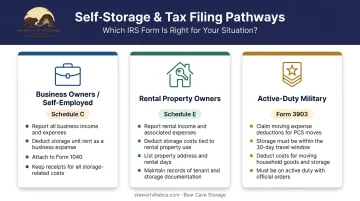
Where you report a storage deduction depends on your tax situation. Each filer type has a specific form and documentation standard:
For Business Owners and Self-Employed Filers
- Report storage costs under "Other Expenses" on Schedule C (Form 1040)
- Label clearly: "storage unit rental — business use"
- Retain the rental agreement, monthly receipts, and an inventory of what's stored
For Rental Property Owners
- Report on Schedule E as a rental property operating expense
- Link the expense to the specific property it supports in your documentation
- Keep receipts and a brief note explaining what's stored and why it's tied to the rental
For Active-Duty Military Members
- Use Form 3903 to claim storage-in-transit and temporary storage costs
- Attach official PCS orders and all storage receipts
- Remember the 30-day limit on temporary storage costs
Consult a CPA or enrolled agent before claiming a storage deduction for the first time. New or unusually large deductions can prompt IRS scrutiny, and having proper documentation — and professional guidance — in place before filing is far better than responding to a notice after the fact.
Tips for Keeping Proper Tax Records
The IRS expects documentation to back up every deduction. For storage unit deductions, retain:
- Rental agreement from the storage facility
- Monthly payment receipts (Bear Cave Storage offers online bill pay with 24/7 account access, making it easy to pull records anytime)
- Written inventory of what's stored and how each item connects to your business
- Photos of unit contents, ideally taken when you first load the unit
- Any correspondence with the storage facility
How Long to Keep Records
The IRS generally recommends keeping records for at least 3 years from the date you filed the return, or 2 years from the date you paid the tax — whichever is later. If you underreported income by more than 25%, the IRS has 6 years to audit. Keep records longer if there's any uncertainty about your filing.
When in doubt, keep more than you think you need — a single missing receipt can cost you a deduction if you're ever audited.
Frequently Asked Questions
Can I write off a storage unit for my business?
Yes — provided the unit is used exclusively (or at minimum, predominantly) for business purposes, the rental cost qualifies as an ordinary and necessary business expense. Claim it under "Other Expenses" on Schedule C.
What is the $2,500 expense rule?
The IRS de minimis safe harbor lets businesses immediately deduct tangible property purchases of $2,500 or less per item instead of capitalizing them over time. It applies to items you store (like equipment), not to the storage unit rent itself.
What is the $400 rule for self-employed people?
Self-employed individuals with net earnings of $400 or more must file a tax return and pay self-employment tax. If you're renting storage for your work, you're almost certainly required to file already.
What expenses are 100% deductible?
Storage rent for a unit used exclusively for business can be 100% deductible, along with business insurance, professional subscriptions, and ordinary operating costs.
Can I deduct storage for my rental property?
Yes. Storage costs directly tied to maintaining or managing a rental property — tools, appliances, repair supplies — are deductible on Schedule E as a rental property operating expense.
Do I need to keep receipts for my storage unit deduction?
Yes. The IRS requires documentation to substantiate all deductions. Save your rental agreement, payment receipts, and a written inventory of what's stored and why it's business-related.