This guide walks through exactly how to calculate your total storage cost across multiple months: a clear formula, a worked example using real rate benchmarks, and practical tips to avoid overpaying.
Key Takeaways
- Total cost formula: (Monthly Rate × Number of Months) + Prorated Amounts + One-Time Fees
- Partial months are typically billed by the day, so ask your facility how they prorate move-in and move-out dates
- One-time fees (admin, insurance, lock) are added once, not multiplied by months
- Rate increases are common for long-term renters — ask about rate stability before signing
- Committing to 6 or 12 months can unlock meaningful discounts at some facilities
What Makes Up Your Monthly Storage Cost?
Before running any numbers, you need to know what's in your monthly bill.
Unit Size Drives the Base Rate
Unit size is the single biggest factor in your monthly rate. According to SpareFoot's January 2026 industry data, average non-climate-controlled rates break down roughly like this:
| Unit Size | Avg. Monthly Rate (Non-Climate) |
|---|---|
| 5x5 | ~$52 |
| 5x10 | ~$74 |
| 10x10 | ~$119 |
| 10x20 | ~$193 |
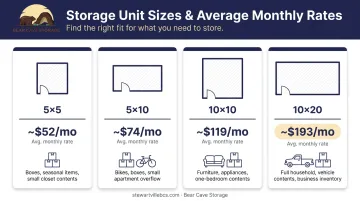
At Bear Cave Storage in Stewartville and Rochester, MN, indoor unit pricing starts at $70/month for a 10x10 on a month-to-month basis, with larger units ranging up from there.
Indoor vs. Outdoor Units
Unit size sets your base rate, but the type of unit adds another layer. Indoor units generally cost more than outdoor drive-up spaces — Bear Cave Storage's outdoor fenced storage starts at $65/month on a month-to-month basis, noticeably less than comparable indoor units.
Bear Cave Storage does not offer climate-controlled storage, which keeps pricing straightforward. At facilities that do offer climate control, expect to pay 10%–50% more per month for that feature.
One-Time and Monthly Add-On Fees
Beyond the base rent, watch for these line items:
- Admin/move-in fee — one-time, usually $10–$25
- Tenant protection — $10–$30/month depending on coverage level; Bear Cave Storage offers this as an optional add-on
- Lock — disc locks run about $10 if not provided by the facility
- Security deposit — less common but worth confirming with your facility
The Formula for Calculating Storage Costs Across Multiple Months
The Core Formula
Total Storage Cost = (Monthly Rate × Number of Full Months) + Prorated Amounts + One-Time Fees
Each variable:
- Monthly Rate — your confirmed per-month rental price for your specific unit
- Number of Full Months — complete calendar months you'll be renting
- Prorated Amounts — partial months at move-in or move-out, calculated by the day
- One-Time Fees — admin fee, lock purchase, insurance setup; added once, not per month
How Prorated Billing Works
Most facilities bill partial months by the day:
Prorated Amount = (Monthly Rate ÷ Days in Month) × Days Used
For example, if your monthly rate is $108 and you move out on the 10th of a 30-day month: ($108 ÷ 30) × 10 = $36 for that partial month
Check your facility's policy: Proration policies vary by facility. Some operators — including large national chains — do not refund unused days if you move out mid-month. Always confirm your facility's specific policy before assuming proration works in your favor at move-out.
Handling One-Time Fees
One-time fees get added to your total a single time — not multiplied by months rented. A $20 admin fee is just $20, whether you rent for two months or twelve. Some facilities waive this fee for longer commitments, so it's worth asking before you sign.
Rate Changes Over Long Rentals
One-time fees are easy to account for — ongoing rate increases are harder to predict. According to industry data from Inside Self-Storage, existing-tenant rate increases typically run 8%–15% and can kick in as early as five to seven months into a rental. SpareFoot's 2026 cost guide puts the range at 5%–10% every six to eighteen months.
Ask your facility directly: "How often do you review rates for existing tenants, and how much notice do you give before an increase?"
With those variables in hand, here's how they combine in a real scenario.
Worked Example
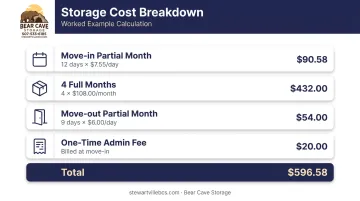
Say you rent a 10x10 indoor unit at $108/month (month-to-month rate). You move in on the 5th of a 31-day month, rent for 4 full months after that, and move out on the 15th of the final month (30 days).
| Line Item | Calculation | Amount |
|---|---|---|
| Move-in partial month (26 days) | ($108 ÷ 31) × 26 | $90.58 |
| 4 full months | $108 × 4 | $432.00 |
| Move-out partial month (15 days) | ($108 ÷ 30) × 15 | $54.00 |
| One-time admin fee | — | $20.00 |
| Total Estimated Cost | $596.58 |
Step-by-Step: Calculating Your Total Multi-Month Storage Cost
Step 1 — Find Your Monthly Rate
Get the exact monthly rate for your unit size and type. Before locking in a number, confirm two things:
- Does the quoted rate include taxes and mandatory fees, or are those added at checkout?
- Are discounted rates (6-month, 12-month) reflected in that quote?
Bear Cave Storage's pricing pages show rates by unit size with clear breakdowns for 1-month, 6-month, and 12-month options.
Step 2 — Determine Duration and Account for Partial Months
Count your full months first. Then check:
- Do you move in on the 1st, or mid-month? (partial start month)
- Do you plan to move out before the last day of a month? (partial end month)
Calculate each partial month using the daily proration formula above.
Step 3 — Add One-Time and Optional Fees
List out all non-recurring charges:
- Admin/move-in fee
- Security deposit (if applicable)
- Lock (if you need to purchase one)
- Tenant protection/insurance setup
Add these to your running total once.
Step 4 — Calculate and Sanity-Check Your Total
Final addition: (Full Months × Monthly Rate) + Prorated Partial Months + One-Time Fees = Total Estimated Cost
Build a simple table in a notes app or spreadsheet to track each line item. It takes five minutes and prevents surprises when the bill arrives.
Step 5 — Compare Unit Sizes
Once you have your total, run the same calculation one size up and one size down. A slightly smaller unit can save meaningfully over several months — but a unit that's too small risks forcing a second rental, which costs more in the long run.
Bear Cave Storage's unit descriptions map each size to specific use cases (apartment contents, vehicle storage, full house contents), so you can quickly spot whether a 10x10 or a 10x20 fits your situation — and what the monthly cost difference actually is.
Factors That Can Affect Your Total Cost Over Time
Month-to-Month vs. Longer Commitments
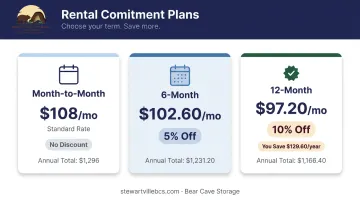
Month-to-month rentals offer flexibility but usually cost more per month than longer agreements. Bear Cave Storage rewards longer commitments with 5% off for 6-month rentals and 10% off for 12-month rentals. On a $108/month unit, a 12-month commitment drops the rate to $97.20/month — that's $129.60 back in your pocket over a year.
Seasonal Pricing
SpareFoot's 2026 cost guide notes that storage prices typically peak May through September and bottom out November through March. If you're planning storage during peak moving season in Minnesota, locking in a unit and rate early avoids both availability issues and potential higher rates.
Rate Adjustments for Long-Term Renters
Locking in a low rate is only half the equation. The average self-storage tenant stays 18.5 months — long enough to experience at least one rate review cycle at most facilities. Before signing, ask about:
- The facility's rate adjustment policy
- How much notice you'll get before any increase
- Whether long-term tenants are protected from mid-lease changes
Tips to Keep Your Multi-Month Storage Costs Down
Right-size your unit from the start. A 10x10 fits a two-bedroom apartment's worth of furniture; a 10x20 handles a full house. Paying for the larger unit when the smaller one would do means overpaying every month. Bear Cave Storage carries a range of indoor and outdoor unit sizes across Stewartville, Rochester, Byron, and surrounding towns — so you can match the unit to your actual load.
Ask about promotions before reserving. Multi-month discounts or move-in specials won't always appear on the website rate card. A quick call to Bear Cave Storage at (507) 533-6185 can surface deals that aren't listed online.
Reassess if your timeline extends. Two months can quietly turn into six. If that happens, check whether you can downsize or declutter — the difference between an $108/month unit and an $83/month unit adds up to $150 over six months.
Consider committing to 6 or 12 months if you know you'll need the space. The discount compounds over time and provides rate stability, at least for the committed period.
Frequently Asked Questions
How do I estimate total storage costs for multiple months?
Multiply your monthly rate by the number of months you plan to rent. Add prorated amounts for any partial start or end months, then add one-time fees like admin charges. The result is your total estimated cost.
What is the formula to estimate storage space requirements?
Calculate the cubic footage of your items (length × width × height per item, then total them) and match that volume to a corresponding unit size. Bear Cave Storage provides unit descriptions that map sizes to typical household contents, making it straightforward to find the right fit.
Does storage cost change month-to-month?
At most facilities, your rate stays consistent unless the facility issues a formal rate adjustment, which is typically communicated 30 days in advance. Ask your facility how often they review rates before committing.
How do I calculate storage cost for a partial month?
Divide your monthly rate by the number of days in that month, then multiply by the days you'll actually occupy the unit. Confirm whether your facility applies this method at both move-in and move-out, since some don't prorate unused days at move-out.
Are there discounts for renting storage for multiple months?
Many facilities offer promotional pricing or term-based discounts. Bear Cave Storage offers 5% off for 6-month commitments and 10% off for 12-month commitments — ask before reserving, as not all promotions are listed publicly.